Category: Uncategorized

  • Rise and fall of the A-league

    At one point the A-League seemed poised to dethrone the AFL as Australia’s top sport. A sleeping giant had stirred, seemingly on course to dominate the sporting landscape. Fuelled by the passion of second-generation European Australians, the league surged in popularity under near-perfect conditions. Now, the league has slipped into irrelevance for the average Aussie sports fan, rarely discussed and even less often watched.

    Originating in 2005 with eight founding clubs, the A-League quickly grew in popularity. This surge was at least partly due to Australia’s incredible 2006 World Cup run, led by a now iconic lineup featuring players like Tim Cahill and Mark Viduka. That success carried over to the A-League, which recorded its highest-ever average season attendance of thirty one thousand people per game in 2007. That was 18 years ago, and attendance has steadily declined ever since.

    It’s not all doom and gloom for the league, though. There have been some small shines of hope. Their record attendance, more than 61,000 people came in 2016. Unfortunately for the league, this figure was an outlier compared to the rest of the league’s games that year.  Despite this glimmer of hope, the A-League failed to build on the momentum. Since then, attendance has steadily declined, hitting a shocking low of just 38 spectators at a game in 2022.

    Currently, eight of the league’s 13 teams average fewer than ten thousand fans per game. To put that into perspective, no AFL club averaged fewer than ten thousand attendees per game last season. Auckland FC, the A-League’s best-attended club last season, had a total season attendance that still fell short of the AFL’s most attended game. The Essendon vs. Collingwood match drew more fans in a single game than Auckland FC did over the entire season.

    Despite being the third most-played sport among Aussie kids, A-League broadcast numbers resemble daytime TV ratings more than those of a professional sports league. Comparing A-League ratings to the AFL or NRL feels almost cruel. So, why has it failed? The A-League was supposed to challenge the AFL, but after 20 years, it has fallen flat.

    When the Socceroos qualified for the 2006 World Cup, soccer fever in Australia was at an all-time high. Two decades later, our domestic league is almost entirely forgotten. This is partly due to the league’s culture.

    The AFL excels at turning kids who play footy for fun into lifelong fans, creating a steady revenue stream for the league. It starts by getting families to game. Offering free passes, promotions, and a welcoming environment for parents and children. Most importantly, their games are family-friendly, making it easy for parents to bring their kids.

    As they grow, these kids become devoted supporters, spending millions on their favourite clubs, filling massive stadiums, and tuning in weekly. Young fans are the foundation of any successful sports business model.

    One thing the A-League struggles with? Attracting families to games. Thousands of children across Australia play soccer, yet instead of filling stadiums with families, the league has failed to convert these young players into lifelong supporters. The A-League had a chance to replicate the AFL’s success with Auskick by engaging young fans early. Instead, it fostered a rowdy ‘hooligan’ culture that alienated families.

    For families to attend, they need to feel safe. The A-League has been marred by fan arrests and violent incidents. What parent would take their seven-year-old to a game where flares are hurled and violence is common? Rather than tapping into the lucrative family market, the A-League built its fan base around 18- to 22-year-old males. An approach that has backfired commercially.

    Another major misstep was placing their TV product behind a paywall too early. Pay TV brings in big money, funding player salaries and filling executive pockets but it doesn’t drive long-term growth. Locking the A-League behind a paywall was a short-sighted decision. Securing broadcast rights on commercial free-to-air TV would have introduced the A-League to families who had never watched the sport before. Getting future fans to casually tune in on a Saturday or Sunday night is key to building long-term financial success.

    Soccer is already the third most-played sport in Australia. Kids clearly love playing it. watching it? That’s another story. Many would likely become fans if given the chance, yet they can’t unless their parents pay for it. If a family doesn’t already follow soccer, they’re unlikely to pay for it. As a result, kids who play soccer at school or on weekends come home and end up watching AFL or rugby instead. this is even more true for families where neither parent grew up playing soccer. Statistically, the majority of Australian households.

    It’s not just the A-League’s own missteps that brought them here. The truth of the matter is they may or may not have been able to compete with the likes of the AFL and rugby league. They were in a strong position to give it a try. Whilst they made quite honestly every wrong step they possibly could have, they aren’t just competing with Australia’s two largest sports. Soccer is a global sport with massive leagues across the globe. With so many high-quality leagues to choose from, soccer fans have endless options. Soccer fans are spoilt for choice and the A-league has fallen short. The standard of play in top international leagues is significantly higher. A league is in trouble when its own fans can easily find a superior product elsewhere.

    The A-League, once a sleeping giant poised to challenge the AFL, has drifted back into hibernation. Over the past decade, expansion efforts have largely failed to gain traction. Without a major shift in its internal culture, the league is unlikely to reawaken anytime soon.
  • Building Jurassic World

    Bioscience companies are turning science fiction into reality. In the past year alone, Colossal has revived the Dire wolf and introduced a woolly mouse. A key step toward resurrecting the woolly mammoth. A real-life version of the Jurassic World zoo may no longer be a fantasy. Thanks to cutting-edge advances in genetics, the question isn’t if this will happen, but when.

    In the twenty-first century, visiting a zoo feels a bit outdated. Much like the circus, which lost its charm after the 1930s, zoos have shifted focus from entertainment to conservation as visitor numbers have declined to unprofitable levels. There was a time when zoos were the only way to see exotic animals. If my great-grandfather wanted to see a lion, he had two choices. Wait for a traveling circus to come through his town or visit a city zoo. That was it. Today, if I want to see a lion, I just pull out my phone and I can see more lions in five minutes than he could have imagined in 1920.

    The honest truth is that zoos no longer make financial sense. Crowds aren’t lining up to see elephants in person anymore, and there are no newly discovered monkeys from distant lands to capture a city’s imagination. Thankfully, animal rights have come a long way which means no more animal performances to draw a crowd. The zoo industry is hanging on by a thread. Even Melbourne Zoo is in the process of “de-zooing.” In ten years, they envision a space that looks more like an ecological garden than traditional animal exhibits.

    That could all change with the return of woolly mammoths, Tasmanian tigers, and Dire wolves. Imagine the line to see a woolly mammoth back from extinction, alive and breathing right in front of you. A real-life Jurassic Park raises a fascinating question. How much would it actually cost to build something like that? What would it take, financially, to recreate the park pictured in Jurassic World? The idea might not be as far-fetched or as far away as it once seemed.

    In the movie, the park map features twenty different dinosaur species. By combining details from the film with data from large international zoos, we can estimate what it might take to care for these prehistoric stars. A team of 10 genetic scientists, 5 palaeontologists, and a 120 animal caretakers would likely be required to meet their needs. Staffing alone would cost around $7.8 million per year.

    Genetic Scientists – 260’000*10

    Palaeontologists – 120’000*5

    Animal Caretakers – 65’000*120

    Total = 7’800’000

    That’s just the cost of caring for the animals. Let’s go back to the beginning. Acquiring the island, clearing roads, and building harbour and helipad infrastructure would cost nearly $2.2 billion at today’s rates. Private islands large enough to house a park like this don’t come cheap. Constructing hotels, a visitor centre, control rooms, and similar facilities would add another $4 billion. Estimating the cost of the gyrospheres featured in the film was a bit tricky. We treated them as high-end amusement park rides rather than transportation infrastructure. If you consider them more of a transport project, the total construction cost jumps closer to $6 billion.

    Once the animal pens are built and the main facilities are in place, the park would need to be just as high-tech as the one we see in the movie. The control room, for example, appears to have at least 12 IT system engineers working at any given time based on scenes featuring Bryce Dallas Howard. That suggests a full team of around 40 staff would be required. With an average salary of $125,000 per year, that adds another $5 million annually in control room staffing costs.

    The park is shown to have 14 herbivores and 6 carnivores. You might think estimating the cost of feeding a T. rex and its prehistoric friends would be difficult but it’s actually easier than you’d expect. Fortunately, the San Diego Zoo has published data on the cost of feeding their animals. By breaking those costs down by weight and adjusting for inflation, we can apply them to what we know about the dinosaurs’ eating habits. The best estimate? Around $400 million per year just for food.

    Of course, the park would also have restaurants and merchandise. Jurassic World is packed with branded gear and souvenirs in the movie and all of that costs money, surprisingly a lot. By counting the number of direct-to-consumer stores and food vendors shown, and applying industry averages, stocking Jurassic World with all its goodies would cost around $500 million. That’s more than the cost of feeding the prehistoric beasts.

    One thing we see throughout the movie is the theme park staff liaisons helping visitors with directions, tickets, and other needs. A park the size of Jurassic World would require around 2,000 employees, plus an additional crew for maintenance. Staffing and operations would add another $200 million per year.

    Have you been keeping track? There’s just one more line item to consider, and this was perhaps the trickiest to estimate. At the centre of Jurassic World is the Mosasaurus enclosure. It features a stadium that moves underground during the show, a huge feeding mechanism and a massive pool of water. Since we know the size of the Mosasaurus, this is our best chance at making an estimate.

    The mosasaur pictured in the film is between 20 – 30 metres. The stadium sits roughly 30 – 40 feet above water, as seen when the mosasaur jumps for its food at the beginning of the movie. The full mosasaur is seen lunging full bodied from the bottom of the pool, using some other frames, the pool would have to be roughly 100 feet deep. More importantly, around 18.7 million gallons of water. That is more than 6 Olympic swimming pools worth of water. After a lot of referencing back and forth between stadium construction, concrete rates, using everything currently available my best estimate is that the attraction alone would set the park back 2.5 Billion dollars to complete. It is just so large and so complex.

    Building Universal Studios is estimated to have cost around $7 billion USD. Our estimate to build a real-life Jurassic World comes to $9.3 billion USD. That is about 14.3 billion AUD at the current exchange rate. This is a conservative estimate. Unfortunately, this doesn’t include the cost of the dinosaurs themselves. For that, we’ll have to wait and see what Colossal can come up with.

  • Dividend vs Growth investing

    Have you ever thought about how investing today can set you up for a secure future? Stocks are one of the most accessible ways to grow your wealth over time, requiring far less capital than real estate. Unlike property, investing in stocks doesn’t demand a large upfront investment. Stock investors generally follow two main strategies. Growth investing or dividend investing.

    Dividend investing involves buying stocks in companies that distribute a portion of their profits, known as dividends, to shareholders. These companies are typically well-established, financially stable, and generate consistent profits.

    Investors who follow this strategy aim to generate income quickly. This approach allows them to start earning income soon, making it ideal for those seeking steady cash flow. Not all companies pay dividends. Instead, a company may reinvest its profits or may not have generated a profit at all. Dividends are never guaranteed, and companies that pay them can adjust the amount over time.

    Growth investing takes a different approach, focusing on appreciation rather than immediate income. This strategy involves buying stocks with the expectation that their prices will rise, allowing investors to sell later for a profit. Successful growth investors can significantly increase their wealth, often outpacing returns from dividend investing. For example, an investor who bought Google or Amazon stock in the early 2000s and held onto it would have seen massive gains. This strategy typically targets younger companies that prioritize innovation and market disruption.

    Both investment strategies come with their own risks. Not all growth stocks live up to their potential. Some companies may never turn a profit or fail to meet investor expectations. For every Amazon, there are thousands of failed companies that you barely remember. Growth stocks tend to struggle during economic downturns. Expansion becomes difficult when consumers cut back on spending. High cash burn and lack of earnings quickly become major risks.

    That doesn’t mean that dividend investors aren’t immune to risk either. When a company’s earnings decline, it often reduces its dividend. Investors can never be certain how much dividend they’ll actually receive. During high inflation, dividend returns may not keep up with rising costs, making the investment less attractive. Even large, established companies can fail. Kodak is a prime example. It was once a dominant company favoured by many dividend investors, but today, those investors have lost most, if not all of their investment.

    While both strategies have their pros and cons, investors must be self-aware. One strategy will align better with an investor’s personality and financial goals. Growth investors must be patient, as returns often take years to materialize. They also need other sources of income and must accept that growth is never guaranteed. They have to be comfortable with that risk. On the other hand, dividend investing prioritizes income and tends to be less volatile. This makes it a better fit for certain investors. For example, retirees often prefer dividend investing for its steady income. Ultimately, self-awareness is key to choosing the right strategy.

  • The shrinking ASX

    The Australian Securities Exchange (ASX) subtly reflects the ups and downs of Australian businesses. Stock prices fluctuate throughout the year. Good companies often rise, though nothing is guaranteed. Some investors make fortunes, while others lose everything. That’s the nature of the stock market. What about the ASX itself? Beyond being a marketplace for shares, it is also a business in its own right.

    The ASX faces a major issue. While the companies on the exchange have grown over time, the number of listed companies on their exchange has been shrinking. At the end of 2024 there were just over two thousand companies to invest in. That may sound like a fair bit but it’s down one hundred companies in the last two years alone. That signals a worrying trend for Australia.

    Looking at a ten-year trend, the numbers don’t look much better. In fact, the trend is concerning. Over the past decade, the number of companies listed on Australia’s major stock exchange has grown by just 25. The vast majority of which came between 2015 to 2018. Business confidence in Australia is at an all-time low, yet few seem to be paying attention to this growing problem.

    Generally speaking, There are two main ways an economy can grow. The first is through population growth. The more people, the more production. The second is technological advancement. Imagine a farmer working eight hours a day with hand tools. Now picture that same farmer using a tractor. His productivity skyrockets. Technological advancements allow workers to produce more with the same effort. This is called an efficiency gain. These advancements typically come from business investment.

    Since the mid-1990s, most Australian states have had birth rates below the replacement level (fewer than two children per couple).That leaves us with two main drivers of economic growth. Immigration and business investment. Yet, the ASX and its customer base is desperate for more listed companies. Entrepreneurship is more popular than ever. You’d expect a surge of young Australian businesses to invest in over the past decade, but that hasn’t happened

    One reason could be that Australia’s property market has drained retail investor capital from the ASX. In Australia, it’s far more common to own an investment property than a stock portfolio. People dream of owning a second home, but few are eager to invest in stocks like Star Casino or Coles. Who can blame them? The tax benefits of property investment are hard to ignore. Decades of policies like negative gearing have made the ASX an afterthought for most everyday investors. That’s a big problem because parking hundreds of thousands of dollars in a suburban apartment doesn’t exactly drive productivity. From an innovation perspective, it’s not a great use of capital.

    The property market isn’t the only factor to blame. The ASX has struggled to attract top companies, unlike its global competitors. Put simply, investors are choosing New York or London over Sydney. Investors prefer Tesla, Disney, Apple, and Amazon over Woolworths and Coles. This wasn’t always a problem. Twenty years ago, small investors had little access to overseas markets. Excessive paperwork and high minimum buy-ins were major barriers, keeping money in Australia instead of flowing to America. Times have changed. It isn’t 2005 anymore. The internet wasn’t a fad, it revolutionized finance. Today, Australians can invest in global stocks for less than a few hundred dollars with just a few clicks.

    Back in 2008, if you wanted to invest in shares, the ASX was pretty much your only option. That is no longer the case. Today, investing in international shares takes just minutes using trading apps, with almost no hassle. The ASX’s response hasn’t been to list more companies. It hasn’t been to attract exciting Australian companies either. Instead of competing, they’ve listed fewer and fewer new companies. Not exactly a winning strategy.

    Australia’s economy has stalled in innovation, with most wealth flowing into property instead. As a result, our economy has become a one-trick pony, relying heavily on mining for wealth. Beyond mining, we do little else to generate real economic growth. If mining were removed, Australia would drop significantly on key economic indicators. We would actually drop out of being a “developed nation” on some of those economic indicators. Rather than fostering innovation, we depend on immigration for economic growth. Mining is a finite resource, and it won’t sustain us forever.

  • Death of retirement.

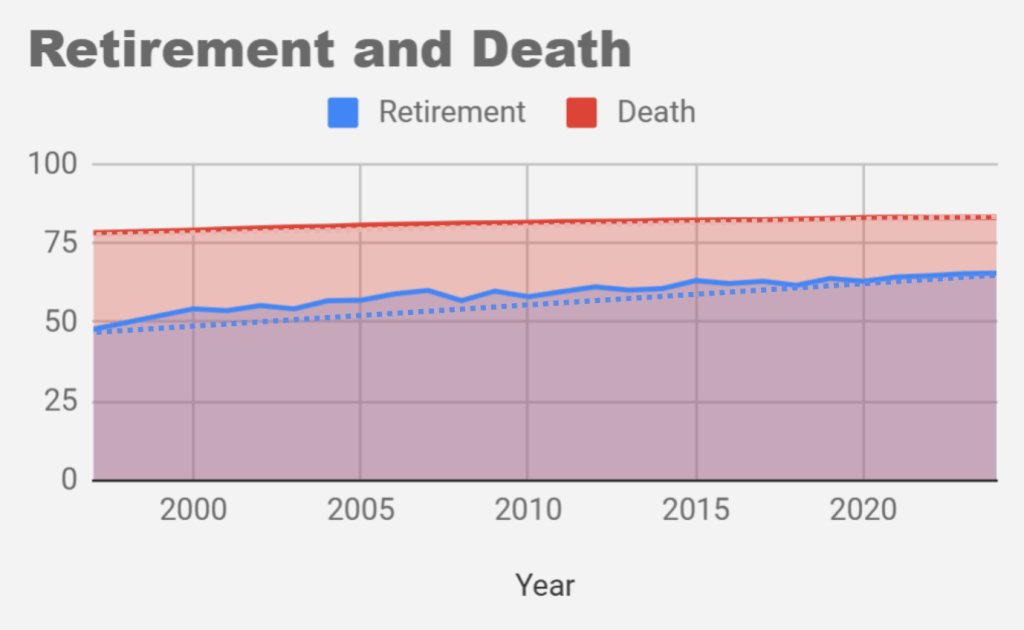
    What was once a promised staple of the Australian dream is now in jeopardy for anyone currently under the age of thirty. The numbers don’t lie. The numbers are alarming and stark. Retirement is slipping out of reach. The age pension is thirty thousand dollars a year, barely covering even the basic bills. At this rate, many Australians may not be able to afford retirement before they pass away. The age people can afford to retire is about to outpace our average lifespan.

    In 2004 the average age to retire was just 56 years old, even younger if you were a woman. That is nearly a decade earlier than it is today. For someone who started working between 18 and 20, that meant roughly 36 years in the workforce. Today, the average retirement age has risen to 65, and even later for men. That’s a whopping 48 years in the workforce. The length of the average career has stretched significantly.

    Superannuation was designed to support Australians in retirement, yet people are retiring later than ever. A lack of education and awareness about superannuation means most retirees still rely on the age pension as their main source of income. Many Australians only start paying attention to their super when it’s too late to make a difference. Historically, women have retired earlier than men, but even that trend is shifting as women now retire later than ever.

    The retirement age is rising faster than life expectancy. If these trends stay consistent the average age to retire will be older than the average lifespan for Australians. At this rate, more people will die while still employed rather than ever reaching retirement.

    All things staying consistent, retirement age outpaces average age of death in roughly twenty five years. That is to say, you will die before you hit retirement age. Without some form of change, Australians will be worked to death. This might sound extreme, but consider this, In 1997, Australians retired at just 48 years old. Today, most don’t retire until their later 60s. If this pattern holds, the average retirement age will push into the late 80s or early 90s, well beyond most people’s life expectancy. Barring some unbelievable jump in medicine, the average lifespan will not grow as fast. 

    When we dive into the numbers, large mortgages are mostly to blame for this worrying trend. As house prices climb, mortgage debt has ballooned, stretching repayment timelines while Aussie wages have lagged behind. Of course large mortgages come with large deposits. People are taking out their first mortgage later than ever. Delaying homeownership means delaying the final mortgage payment, which often delays retirement. Unfortunately that means that people stay working for longer. For perspective, both sets of my grandparents owned their homes outright before most people today even qualify for a mortgage. Their mortgage was also faster to pay off once they had one because wages were higher relative to house prices.

    The Silent Generation (now mostly in their 80s and older) had to retire without superannuation, relying entirely on the age pension. By contrast, their children who benefited from the introduction of superannuation in 1992 have spent about half their working lives saving for retirement. They’ve witnessed their parents struggle to cover basic expenses on the meager age pension. Seeing the financial insecurity of their parents, many now fear retiring without enough super to sustain them. As a result, many keep working, knowing the age pension isn’t enough and that their super falls far short of what they need.

    Retirement isn’t just about finances, it’s also about maintaining social connections. Families have become smaller over the years, many people approaching retirement are finding themselves more isolated. When polled, those close to retirement age listed social isolation as their second highest concern when considering retirement. Our communities aren’t as strong as they once were. They are far less connected than in the past. Many people don’t even know their neighbours’ names anymore. More people are staying in their jobs longer, at least partly for the social interactions it offers.

    The death of retirement has had some major effects on our society as a whole. Besides the obvious decline in quality of life, as people spend less time in leisure during retirement, this shift has impacted so much of our everyday lives. Social, economic and career upheaval, all as a result of people working far longer.

    The delay in retirement has made career progression slower within companies. This slowdown in career advancement has also contributed to a decline in company loyalty. Top jobs are usually occupied by those with the most experience, typically older employees who have had more time to accumulate it. In past generations, these older employees would retire well before age 60, allowing younger workers to move up the ladder.Now, with people retiring much later, they’re unlikely to give up their high-paying jobs to make room for younger employees. Older generations often complain that younger employees lack company loyalty. Why would they have any loyalty? The corporate ladder is clogged because top positions aren’t being vacated by retiring employees.

    So the career paths of young workers are narrowed. As a result, the career paths of young workers are increasingly limited. There is a traffic jam at the top of the corporate ladder. Compared to retirees in the 1990s, older workers are staying in their jobs nearly twenty years longer. For younger workers, the only way to advance is often by changing companies when possible. The days of staying with one company for an entire career are long gone. The death of retirement killed any upward career movement.

    From an economic perspective it isn’t all doom and gloom. The longer someone works, the better it is for the government. The government invests in education and collects taxes on workers’ income, which benefits the economy. In general, a skilled workforce will earn more. This makes education an increasingly valuable investment for the government, as people now spend more years contributing taxes. This means that educating someone has become a better and better investment for the government. Modern workers contribute significantly more in taxes than those from the 1980s due to their higher wages and longer careers. Furthermore, the longer people work, the longer they contribute to production. Increased production leads to greater economic growth for the country as a whole. Today, the economy benefits from nearly fifty years of production from a modern worker.

    Finally there has been a significant social impact of people working longer. Grandparents are no longer retired by the time their grandchildren are born. In previous generations grandparents typically played a much larger role in raising their grandchildren, often providing regular childcare and support. The rise of the childcare industry can, in part, be attributed to grandparents working longer, reducing their availability to care for grandchildren. In the past, it was common for grandparents to help care for children aged zero to five while parents worked. They also played a significant role in the school run for children aged five to twelve. Now, as their grandchildren grow up, they’re still stuck in an office cubicle. 

    Perhaps the true cost of the death of retirement is the loss of the leisure time that many hoped for in their later years. After decades of hard work, nothing. There will be no time for the travel and family milestones that many envision in their retirement. There will be no traveling later in life. There will be no grandparents day at schools. Why? Because retirement is on death’s door.

  • Australian Credit Scores

    Social media ‘Finfluencers’ scream at young people to ‘get a credit card to start building a credit score’. It is a financial trick touted by many misinformed young Australians. While this may be true in the U.S. it doesn’t apply the same way in Australia. America calculates credit scores completely differently than Australia.

    The internet is overflowing with financial advice tailored to Americans. An entire industry of ‘Finfluencers’ has sprung up, offering advice through blogs, podcasts, and YouTube videos. There’s no shortage of content. From Caleb Hammer advising guests to cut back on takeout spending to Dave Ramsey criticizing young people for their student loan debt, there are hours of content. Unfortunately, this wealth of advice doesn’t always translate to Australia. In comparison, the Australian ‘Finfluencer’ scene is smaller and often dominated by property experts pushing overpriced courses with little substance. This lack of relevant content can be frustrating, especially given the strict regulations that limit financial advice in Australia. As a result, many Australians turn to U.S.-based content that simply doesn’t apply to their financial situation.

    A key difference between American and Australian financial systems is how credit scores and credit cards impact borrowing. Credit scores work very differently in each country. In Australia your maximum borrowing capacity matters. Taking out a credit card only reduces that maximum. In America, it can improve your score by showing you can manage small debts. In Australia, lenders focus on your maximum borrowing capacity. Instead of helping your credit score, taking out a credit card actually reduces that amount. Generally speaking if a bank determines you can borrow up to $500,000, but you take out a $10,000 credit card, your new borrowing limit drops to $490,000. It doesn’t matter if you’ve spent anything. Simply having the credit card reduces your capacity. In the U.S., lenders see a $10,000 credit card with no missed payments as proof of responsible credit use, making them more likely to lend you more. This means that while opening a credit card in America can help you build credit, in Australia, it can work against you. This is especially true if you’re trying to qualify for a mortgage.

    In Australia, “building” a credit score isn’t as important as it is in the United States. Australian lenders focus on free cash flow, while U.S. lenders prioritize your history of managing debt. In Australia, banks assume that good budgeting leads to enough cash to cover debts. In the U.S., a long history of successfully managing debt signals creditworthiness. Australian banks want to see that you have excess cash from your paycheck, ensuring you can afford the new loan. They assess your spending habits to determine whether you manage your money responsibly. Put simply, banks prefer lending to someone with consistent savings rather than someone living paycheck to paycheck. One major issue when applying for home loans for young Australians is their online gambling habits. Banks don’t like these types of transactions at all.

    That doesn’t mean credit scores are irrelevant in Australia. We still use them, but mainly as a risk assessment tool. Late payments and defaults can severely damage your credit score, making it harder to borrow in the future. In Australia, the main purpose of a credit score is to signal risk to lenders, helping them limit their liability. In contrast, the U.S. relies on credit scores for far far more.

    In the U.S., your credit score isn’t just for loans. It can also affect job applications and rental approvals. Imagine handing your employer a record of every late bill you’ve ever paid. That’s essentially what happens in America. In Australia, this simply doesn’t happen. In the U.S., financial mistakes from your youth can follow you for years. Credit scores there can feel like a social ranking. Miss a payment, and people may see you as irresponsible. People with poor credit may be locked out entirely from the best jobs and rentals.

    If you’re preparing for a mortgage in Australia, keeping your expenses low is key. Think of it as Australia’s version of proving creditworthiness. Banks focus on how much money you have left after paying your regular bills. They’re hesitant to lend to someone with multiple ongoing financial commitments. A phone plan is one of the few ways to demonstrate serviceability in Australia. It proves you can reliably manage essential bills, but missing payments defeats the purpose and can hurt your score. An average credit score won’t stop you from getting a mortgage, but a bad one will. Avoiding defaults and missed payments is crucial.

    Always remember that not every piece of financial advice you hear on TikTok applies to Australia. In fact, much of it is tailored to the U.S., where credit scores, borrowing power, and financial systems work very differently.

    ———

    The contents of this Article are general in nature and do not constitute financial advice.

  • Currency Debasement

    The average Australian is feeling the financial strain. Grocery prices have skyrocketed since 2020. Property prices have risen outside the reach of many and rent in capital cities are a joke. For young Australians and low-income earners, the dream of owning a home feels increasingly out of reach. Meanwhile, retirees on fixed incomes are struggling to keep up with the rising cost of living. While plenty of blame is being thrown around, there’s little accountability or clear explanation. There’s little accountability or effort to provide a clear explanation for everyday people trying to understand why life feels so much harder.

    Interest rates have risen in an attempt to curb inflation yet prices still rise far beyond what many can cope with. There’s been plenty of talk about how to fix the economy, but the media has largely overlooked an important question. How did we end up here in the first place?

    Let’s rewind back to the year 2020 for a moment. The world had come to a standstill and our country was plunged into lockdowns that lasted for most of the next two years. Whatever your opinion on the effectiveness of lockdowns, they presented the government with a unique problem. Vast number of people couldn’t go to work. They were stuck inside and unlike their careers, their bills weren’t going to suddenly disappear. 

    So what did Australia do? We turned the money printer on. In just twelve months, the country’s money supply almost doubled. To support those who had ‘lost’ their jobs, keep businesses afloat, and assist community organizations, the government distributed this new money. You cannot halt an entire economy without consequences. The government feared that once we reopened, nobody would be willing to go back out and live their lives after being told it was unsafe to do so for so long. To encourage spending, they printed even more money, offering payments to incentivize domestic travel and other activities. For example, Victorians could claim back up to two hundred dollars on a restaurant bill. This money didn’t come from nowhere did it now? The cost-of-living crisis we face today is a direct result of this influx of new money into the economy.

    Currency debasement occurs when a country’s money loses its value, often because the government creates more money than the economy can handle. When someone asks, ‘Why can’t we just print more money?’ This is the reason. There was no doubt that halting our economy meant creating an urgent need for the government to step in and support everyday people. Very few normal people would have made it through lockdowns with no income. The real problem arose when the world began returning to normal

    Think of currency debasement like adding too much water to a pot of soup. The more water you add, the weaker the soup becomes. Similarly, printing too much money ‘waters down’ the value of each dollar, making it worth less.

    We hit pause on everything and added more money to the system. We didn’t bake more bread, build more houses, or produce any additional goods or services yet tthere was suddenly a lot more money circulating in the economy. If anything there was less production during covid. Then, we hit play again. People went back to their jobs, started paying their bills themselves, and resumed their normal lives. It was now out in our economy ready fueling higher prices for groceries and other essentials.

    Think of it like an auction. If there’s only one loaf of bread but more people with extra money bidding for it, the price of that bread will go up. The same thing happens across the board. With more money chasing the same amount of groceries, houses, or fuel, sellers can charge higher prices because there’s more demand backed by extra cash.

    The honest truth is that bread didn’t suddenly become more valuable at Coles or Woolworths. Your dollar is just worth less. Your home’s value hasn’t truly increased. Instead, the money you use isn’t worth as much as it was five years ago. It’s not that your house is worth more dollars—it’s that your dollar buys less house.

    The good news is that there are ways to address the issue. The bad news is that politicians often avoid taking action when it is unpopular. Especially in an election year. 

    In order to balance out all the “extra” money in the economy, the government has to rein in their own future spending. By slowing down spending, the government can offset the effects of newly printed money. By slowing down spending, the government can offset money from flowing through the economy until it balances out. Keeping it simple, if twenty million dollars is printed but the government holds onto twenty million dollars rather than spending it then it is like no new money has entered the economy at all. At least, that’s the idea in principle. 

    Having a weak currency has its downsides but having a strong currency also has its benefits, especially for consumers. For example, in 2013 the Australian dollar was (briefly) worth more than the American Dollar (USD). Take 2013, for example, when the Australian dollar was briefly worth more than the US dollar. Without getting into the technical details, this made goods from the United States cheaper for Australian shoppers. iPhones, sneakers, and makeup cost less in Australia than they did in America at the time because one Australian dollar could buy more than one US dollar. However, a strong currency wasn’t good news for everyone. Australia’s beef industry struggled to sell its products to overseas markets because a strong dollar made our exports more expensive. In response, the government printed more money to weaken the currency. This decision was heavily influenced by political pressure from farmers, who made it clear that keeping the dollar high wasn’t an option. Consumers weren’t a consideration.

    Unfortunately for us it is a federal election year and no politician wants to risk the backlash that comes with cutting government programs. Let’s be honest, no one wins elections by cutting government handouts even if it’s the tough medicine the economy needs right now. For everyday Australians, this means the cost of living crisis is likely to drag on for a while yet.

  • Lipstick effect

    While traditional indicators like GDP figures and unemployment rates provide valuable data, they often feel distant or difficult to interpret. Surprisingly, something as simple as lipstick sales might offer an alternative, more relatable insight into how the country is doing.

    In 2001 an executive at Estée Lauder analysed customer behaviour following both 9/11 and the dot-com crash. Leonard Lauder, was the first to suggest that lipstick sales could serve as a surprising indicator of the overall health of the economy. Just not in the way you think. 

    At first glance, you might expect lipstick sales to rise when the economy is strong, with more disposable income circulating. However, the opposite is true. In reality, lipstick sales tend to spike during economic downturns, a phenomenon that seems counterintuitive. Lipstick becomes a small luxury that people turn to when times are tough. 

    Nothing in our economy exists in isolation. We don’t operate in a sterile lab where only one variable affects the outcome. Every purchase we make involves trade-offs. For example, buying a burger means choosing not to buy a steak. The same principle applies to lipsticks and everything else we spend money on. This concept is known as opportunity cost. When we buy one thing, we forgo another. Regardless of how wealthy someone is, resources are always limited and money really doesn’t grow on trees.

    People have a desire to consume, regardless of whether the economy is booming or struggling. When times are tough, that desire doesn’t disappear, but disposable income does. As budgets tighten, consumers shift their spending—opting for smaller, more affordable indulgences. Instead of splurging on a designer handbag, they buy lipstick. People still treat themselves, but in a way that aligns with their new financial reality.

    At the heart of the lipstick index is the idea that economic downturns create uncertainty about the future. As a result, consumers hold back on large purchases but still seek ways to indulge. Instead of buying luxury goods, they opt for more affordable alternatives. This behaviour is formally known as the substitution effect, where consumers replace more expensive items with cheaper options during tough economic times.

    This also explains why fast food restaurants and movie theatres tend to perform well during recessions. While many assume that fewer people visit cinemas during tough economic times, the opposite is true. Cash-strapped consumers may not be able to afford a five star restaurant, so they opt for a night out at the movies instead. This is the same economic principle that Lauder observed with lipstick sales. As budgets tighten, consumers adjust their spending to match their means, More affordable goods, often referred to as ‘inferior goods’, benefit from this shift.

    Unfortunately for casual investors and amateur economists, lipstick sales data is not usually publicly available. There’s no government agency reporting how well Estée Lauder’s red lipstick sold this month. While the index is rooted in solid economic theory, it’s unlikely to provide timely insights for regular investors. Despite this limitation, a country’s lipstick consumption can indeed predict its downfall. 

  • Cryptocurrency basics

    Cryptocurrency burst into the hearts and minds of everyday households in 2017, when the value of Bitcoin skyrocketed. Although the industry itself began a lot earlier, this was the first time crypto became a topic of mainstream conversation. Seemingly overnight, crypto was everywhere. This curiosity came with a lot of questions about what cryptocurrency really is. At dinner tables, barbecues, and in everyday conversations people asked, “Do you have any Bitcoin?”.

    With so many questions, it’s helpful to start with the basics of what sets cryptocurrency apart. There’s a lot of misinformation surrounding the crypto industry, but at its core, cryptocurrency is a digital currency that operates on a technology called a Blockchain. Think of it like the dollars in your bank account, but with one major difference, no banks or governments control it. Instead, transactions are secured by a decentralised network of computers, volunteered by people worldwide. These computers work together to verify and record every transaction, and, in return, participants earn small rewards in the form of cryptocurrency. It’s a system where no single person, business, or organisation has control, ensuring transparency and security for everyone involved.

    Once purchased, crypto holders have to decide the safest way to store their asset. Cryptocurrency can be stored in two main ways: on exchanges or in “cold storage” wallets. Crypto exchanges are websites that make it easy to buy, sell, and store cryptocurrencies online. However, since exchanges are connected to the internet, they can be vulnerable to hacks or mismanagement. For added security, some people prefer to store their cryptocurrency in “cold storage” wallets. 

    A cold storage wallet is a physical device that often resembles a USB stick. Investors can transfer coins onto in the same way you transfer money from account to account. The digital coins are then untouchable until you reconnect that device into a computer. In this way, cold storage wallets act like a personal safe for your crypto. Although this may seem excessive, it ultimately depends on your risk tolerance. Exchanges are more convenient, but they carry risks. Large exchanges have gone broke before, leaving customers unable to access their funds. A well-known industry saying has emerged from this: “Not your keys, not your crypto.”

    Cryptocurrency is an umbrella term that covers tens of thousands of digital currencies, each with their own unique quirks. With so many coins available it is essential to understand their differences. Let’s start with the ones you’re most likely to encounter as a beginner. Not all of these currencies are created equal. In fact, when most people discuss crypto, they’re usually referring to a small number of leading coins. Bitcoin, for example, is the most recognized and holds the largest market cap (the total value of all its coins in circulation) at the time of writing. Often seen as the “founding father” of cryptocurrency, Bitcoin’s price movements tend to influence the entire market, with many other coins following its trend.

    Ethereum is the second most popular cryptocurrency after Bitcoin. Unlike Bitcoin, which was designed as an alternative to traditional government-issued money, Ethereum was created to support complex digital agreements known as smart contracts. Think of Ethereum’s smart contracts as similar to a vending machine. When specific conditions are met (like inserting the correct amount of money), the contract automatically executes and dispenses the agreed-upon outcome. This technology allows Ethereum to facilitate not just transactions but also decentralised applications (dApps), making it a flexible platform for a wide range of online interactions.

    Outside of Bitcoin and Ethereum, there are other cryptocurrencies called altcoins and meme coins. Altcoins are alternatives to the two major coins, designed to address specific limitations or offer new functionalities. For instance, Litecoin was created to enable faster transactions than Bitcoin, while Solana reduces fees associated with processing smart contracts, a feature that Ethereum is known for. 

    “Meme coins” are a different beast entirely, emerging from the depths of internet culture rather than serious financial innovation. These coins are typically created for entertainment purposes, often gaining popularity due to humorous names or online hype. Entire online communities rally around these coins in hopes of striking it rich, though the coins themselves usually lack any functional purpose. While a few early buyers might profit from sudden price increases, most investors risk losing their money as these coins often resemble pyramid schemes. It’s in this speculative, high-risk space that cryptocurrency sometimes gains its reputation for volatility and risk.

    A common misconception is that cryptocurrency is primarily used by criminals. This perception dates back to the early 2010s, when the now-defunct dark web marketplace Silk Road accepted Bitcoin for illegal transactions. The anonymous nature of Blockchain has also contributed to this reputation. Whilst transactions are traceable, the identities behind them can remain hidden. Despite this stereotype, the industry is not overrun by organised crime. In fact, today, cryptocurrency is widely used for legitimate purposes.

    Many people are drawn to cryptocurrency for its speed and efficiency in payments, especially for international transactions. In many cases, major cryptocurrencies process payments far faster than traditional banking methods. For instance, sending money overseas through a bank can take days or even weeks and incur high fees. By contrast, certain cryptocurrencies can facilitate transactions in seconds, often with little to no fees. This can make crypto a more practical choice for people sending money to family abroad or paying international invoices, as it’s often faster and more affordable than traditional banking systems.

    Beyond this benefit, some people view cryptocurrency as a way to protect their wealth from economic instability, much like gold. When governments print excessive money to fund short-term goals, it can lead to inflation. As we’ve all recently experienced, this can drastically reduce the purchasing power of a consumer’s dollar. Unlike fiat currency, cryptocurrency is generally immune to such government decisions. For instance many cryptocurrencies have a fixed or limited supply. New coins are governed by preset rules rather than political agendas. As a result, some investors choose to convert their cash to crypto to shield themselves from potential economic mismanagement.

    That doesn’t mean that the Blockchain is without issues. Despite its strengths, The technology faces a significant challenge known as the Blockchain trilemma. The issue involves balancing three key principles. Security, scalability, and decentralisation. Security ensures that transactions are safe from attacks, scalability allows the network to handle a large volume of transactions efficiently, and decentralisation prevents control by a single entity. However, no cryptocurrency has managed to achieve an ideal balance of all three. For instance, a secure and decentralised coin may struggle to scale, while a scalable, secure coin might lack decentralisation, making it vulnerable to central control. Although many have attempted to solve this trilemma, a perfect solution has yet to be found.

    From an investor’s perspective, cryptocurrency is an extremely risky asset class. The lack of regulation can leave the door open to fraudsters and unregulated projects, making it difficult for new investors to navigate safely. Even when avoiding bad actors, investors face price volatility. Although stories of crypto millionaires are common, so too are accounts of investors losing it all. Cryptocurrency portfolios can experience rapid swings in value, sometimes losing or gaining large percentages within hours.

    In Australia, exchanges now require licences and must follow a regulatory framework, while in the U.S., the SEC is pursuing projects it deems fraudulent. Additionally, governments worldwide are exploring Central Bank Digital Currencies (CBDCs), which would use Blockchain to create digital versions of national currencies. CBDCs could allow governments greater control over money flows within the economy, impacting aspects like privacy and monetary policy.

    While CBDCs would give governments significant oversight over individual transactions, making it possible to monitor spending patterns, it’s likely that CBDCs will become a part of the financial landscape in some form. Many hope that they will be integrated in a way that complements, rather than replaces, traditional currency. It now seems unlikely that any cryptocurrency will ever fully replace fiat currency. Though Bitcoin emerged over 15 years ago, its adoption for everyday transactions remains limited.

    Instead, the future of cryptocurrency is likely to be in each use case. What I mean by this is the application of cryptocurrencies to solve niche problems is, in all likelihood, the future of the industry.

    Here’s an example. Inner-city apartment buildings have a unique issue. They often lack the roof space needed to install enough solar panels to power every unit. To address this, a cryptocurrency project enables people with solar panels to contribute their excess energy to the grid and earn tokens in exchange. Each token represents a unit of renewable electricity. Residents in apartment buildings can then buy these tokens from the energy company to access renewable energy, even if they don’t have their own solar panels. This allows individuals to pay specifically for energy sourced from renewable sources.

    Another innovative use of Blockchain technology is in the secure tracking of grocery products. Have you ever wondered how long the meat at the supermarket has been sitting on the shelf, or how fresh those tomatoes really are? A system has been developed where farmers attach a unique, secure token to each food package barcode. This token allows consumers to access information such as the product’s harvest date, packaging time, and place of origin by simply scanning the barcode with their phone. Supermarkets can buy these tokens on behalf of the farmers and assign them to individual products, creating a tamper-proof record that builds transparency and trust with their customers.

    The potential applications of Blockchain technology are endless, spanning industries like finance, sport, and governance. Despite this, these digital coins aren’t likely to replace established national currencies like the Australian dollar. Instead, cryptocurrencies are poised to solve meaningful real-world problems by leveraging Blockchain’s unique capabilities. If the industry can achieve widespread adoption and demonstrate practical value, it could have a bright future.

    A quick disclaimer: This article references multiple cryptocurrencies by name and/or function, but none of these mentions should be taken as a recommendation or endorsement. This content is intended solely for educational purposes to provide a basic understanding of the industry. Before making any investments, it’s essential to conduct your own research and make well-informed decisions based on your unique financial situation. Further, within this article there is a link to an Australian crypto exchange (Coinstash). Whilst this exchange is Australian owned and regulated, I do receive material benefit from you clicking the link and/or signing up. The presence of this link should not be taken as financial advice.

  • Crush your debt

    When debt is left unchecked, it can quickly spiral out of control. What may seem like innocent purchases can become suffocating over time. In Australia, thirty eight per cent of people are swimming in credit card debt, and an astonishing twenty two per cent of young Australians are battling buy-now-pay-later debt. On average, Australians carry over $two hundred thousand dollars in debt at any given moment.

    To a large extent, our economy thrives on debt. Cars, houses, and even clothing are often financed in some way. Whether through a personal loan or a credit card, paying in cash has almost become unusual. If you walk into a car dealership and try to pay upfront, they will look at you like you have three heads. Of course there is good and bad debt but what happens when it all becomes too much? It’s natural to feel overwhelmed, but it’s crucial not to ignore the problem. You have options.

    When managing debt, there are generally three widely accepted best practices. Each approach has its own strengths and weaknesses, and what works for one person may not be the best fit for another. The key is to choose the method that suits your situation best.


    AVALANCHE:
    The Avalanche method is an accelerated debt payoff strategy. It’s based on the principle that every dollar borrowed comes with a cost. That cost is represented by the interest rate. So each dollar borrowed at two per cent is cheaper than each borrowed at six per cent. The main idea behind the Avalanche method is to focus on paying off debts with the highest interest rates first, minimising the overall cost of borrowing.

    First and foremost, all minimum repayments on your debts should be made. There’s no point making progress on one debt while falling behind on others, so with the Avalanche method, you start by paying the minimums on all debts. Once the minimum payments are covered, any spare funds should be used to make extra payments on the debt with the highest interest rate. This is because, dollar for dollar, the debt with the highest interest is the most expensive. The focus is on paying off the most costly borrowing first, which refers to the percentage interest rate, not the dollar amounts. For example, a debt with a twelve per cent interest rate should be paid off before one with a six per cent interest rate and so on. Once the highest interest loan is paid off, direct your extra funds to the next highest interest rate, and continue this process until you’re debt-free. As each debt is eliminated, you’ll free up more money to tackle the next one, accelerating your progress.

    The advantages of the Avalanche method are clear. By targeting high-interest loans first, you lower your overall interest expenses and can potentially pay off debt faster. This is because the debt with the highest interest rate doesn’t get a chance to accrue as rapidly.


    However, the downside of the Avalanche method is that it focuses on high interest rates rather than high balances. For example, a loan with a one per cent interest rate on ten thousand dollars would be left until a loan with a two per cent interest rate on a mere thousand dollars is paid off. While the ten thousand dollar loan costs more in total dollar terms, the one thousand dollar debt is technically more expensive due to its higher interest rate.


    This concept can be tricky to grasp. The one thousand dollars costs more because each dollar is priced at two percent compared to one percent on the larger principled debt. However, even a small interest rate on a large balance can result in significant costs in actual dollar terms.

    SNOWBALL:
    The Snowball method is another popular strategy for getting out of debt. With this approach, you focus on paying off your smallest debts first, regardless of the interest rates. The goal is to gain momentum by eliminating smaller balances, which can provide a psychological boost as you work toward paying off the large debts.

    After covering the minimum payments on all debts each month, any spare funds should be directed toward the smallest debt. If you had two debts of a thousand dollars and four thousand dollars, you would focus your extra funds towards paying off the thousand dollars when using the Snowball method. Once the smallest debt is fully paid, you redirect those extra funds to the next smallest debt. This process continues until you’re debt-free. As each debt is eliminated, your available funds will increase, since fewer minimum payments will be required, allowing you to pay down the remaining debts faster.


    The Snowball method can be highly motivating, as you see each debt disappear. These small wins can be especially encouraging for beginners. Unlike the Avalanche method, the Snowball approach is straightforward and doesn’t require much financial literacy. There’s no need to compare interest rates or percentages making it easier to follow for those who prefer simplicity.
    The downside of the Snowball method is that it may not save the most money in the long run. This is because it doesn’t account for larger balances or high-interest rates, which can continue to grow unchecked. As a result, larger debts with high interest will take longer to pay off and could end up costing more overall.


    SAVINGS:
    This approach is less formal but works best when used alongside the Snowball or Avalanche methods. Both of the previous methods mention using extra funds to pay off debts. Therein lies a problem. Many who are being crushed by their debt don’t have spare change to begin with. Creating a budget is one of the most effective ways to control overspending, yet many people either lack the time or the know-how to create one. Some hear the word budget and feel instantly trapped.


    While creating a proper budget is ideal, many people can identify areas of overspending without the need for a complicated spreadsheet. Most of us know where we could cut back for a while. Simple actions like cancelling unused streaming services or meal prepping lunches for work can make a big difference, even in the short term.


    The real key to success is using those newly found extra funds to make additional debt payments, rather than pocketing or wasting them. While this may feel like a temporary sacrifice, it will help you eliminate debt much faster, essentially accelerating the benefits of the Avalanche or Snowball methods. The discomfort is only short-term, and once your debt is gone, you might find that having extra money at your disposal is more satisfying than you expected.


    Regardless of which method works best for you, it’s crucial to pay off bad debts. Beyond the risk of default or dealing with debt collectors, carrying significant consumer debt makes it difficult to build a stable financial future. The more debt you carry, the less disposable income you’ll have in the future. Each time you use credit, you’re essentially reducing the money available to you in the coming months.


    It may seem obvious, but debt must be repaid. For example, let’s say your debt repayment is eighty dollars per week. At first glance, most people think they can manage that. If you reframe the situation and ask yourself, “Is this purchase worth earning eighty dollars less next week?” you might reconsider whether the debt is really worth it. The truth is, that eighty dollars isn’t yours anymore, you’ve already committed it to the credit card company. Instead, that money could be building an emergency fund to avoid panic when unexpected expenses arise, or it could be invested to secure your financial future. At minimum it could be put towards a holiday.


    MORTGAGES:
    This article focuses on methods for paying down consumer debt. The largest debt most people will have in their lifetime is a mortgage. However, including your mortgage in strategies like the Avalanche or Snowball method can derail the process, especially if the balance exceeds one hundred and twenty thousand dollars. Most mortgages in Australia are structured as thirty year terms, intentionally designed to take longer to pay off, allowing banks to profit more from the interest. While there are faster ways to pay off a mortgage, the Avalanche and Snowball methods are specifically tailored for consumer debts, not long-term mortgage repayments.


    Generally speaking, one of the fastest ways to pay off your mortgage is to make more frequent, regular payments. The more often you pay, the faster the mortgage balance will decrease. This is because mortgage interest is typically calculated daily, but most people make payments just once a month, usually at the end of the month. Waiting the full thirty days allows interest to accrue for the entire month. In contrast, paying twice a month reduces the accrual period to about fifteen days, so more of your payment goes toward the principal, and less is lost to interest. While this approach can make budgeting more challenging, it can significantly reduce the length of your mortgage by decades on top of saving you hundreds of thousands of dollars in interest over time.