Author: Shane W. Miller

  • Victoria’s Big Build: A Financial Crisis.

    There’s no doubt that Victoria’s infrastructure was in desperate need of attention. Both road and rail had been struggling to keep up with the demands of its millions of residents for years, relying on outdated upgrades from over thirty years ago. Congestion and safety concerns made it clear that major upgrades were needed. In response, the state government unveiled The Big Build in 2015, a comprehensive series of projects aimed at modernising Victoria’s roads and rail systems. Unfortunately for taxpayers, this initiative has far exceeded its original budget, with costs ballooning from millions to billions with no end in sight.

    Westgate Tunnel.

    The West Gate Tunnel is essentially a reimagining of the earlier East-West Link project. Homes had been forcibly acquired, and tunnelling contracts were signed for a route that would have connected Melbourne’s western suburbs, to the east. Despite the project’s progress, a change in government following the election led to the project’s abrupt cancellation. The cancellation cost Victorian taxpayers approximately $300 million, a staggering amount for a tunnel that was never built. Imagine the difference those funds could have made if they had been redirected to critical services like Medicare. This costly misstep set an unfortunate precedent for Victoria’s infrastructure spending, foreshadowing the financial struggles that would follow.

    Rather than linking Footscray to the eastern suburbs as initially planned, a new tunnel was proposed, connecting Altona to Docklands. The goal was to divert trucks off the congested West Gate Bridge, reducing bottlenecks and improving road safety. The original East-West Link tunnel was expected to cost $1.5 billion, while the West Gate Tunnel was projected at $5.5 billion. However, the cost has now escalated to an astounding $10 billion, driven by delays, design changes, and challenges with toxic soil. This is an astounding $8.5 billion over the original proposal, and for a much shorter stretch of road.

    Originally scheduled for completion in 2022, the project remains unfinished as of late 2024. Spanning just 4 kilometres The state of Victoria is running out of money. July saw a grimm warning for the state from lenders that they will look to avoid lending the embattled state further money. One of the main culprits behind this financial downturn is the state’s ambitious infrastructure project, The Big Build, which has stretched our resources to breaking point.

    and now in its ninth year of construction, progress has been underwhelming, averaging an underwhelming 500 metres per year. To make matters worse, ongoing construction challenges have sparked rumours that an additional $1.1 billion will be needed to bring the tunnel to completion. If true, this would mean that Victorians are paying a staggering $3 billion per kilometre of road.

    Even conservatively estimating that the works have added 20 minutes to the average daily commute, someone who crosses the bridge for work every day would have spent an additional 780 hours (32.5 full days) stuck in traffic. It’s hard to imagine how commuters could ever recover that lost time. This lost time will be even harder to swallow once the tunnel opens as a toll road.

    Metro Tunnel.

    Nine kilometres of new underground rail with five new stations will ultimately connect the Pakenham line with the Sunbury line. Announced in 2017, the project is on track for completion by 2025. So far, this rail infrastructure upgrade has cost taxpayers a staggering $14 billion.

    Melbourne’s city loop was plagued by design flaws, creating bottlenecks at Flinders Street Station and causing frequent delays for decades. The Metro Tunnel was introduced as the first step in resolving these issues. The project is also considered necessary for a future train line direct to Melbourne Airport (more on that later). As part of the project, 63 houses and 31 businesses were forcibly acquired, roads were closed, and the city loop endured five years of disruptive construction. Meanwhile, the Flinders Street end of Swanston Street became a construction zone, stripping the area of all its former activity.

    The original plan to build the upgrade above the existing city loop was ultimately deemed impractical, forcing a costly redesign. Unsurprisingly, this change added an extra $1 billion to the original budget. Why would they care, when it’s not their money, right?

    The project averaged 90 metres of track laid per week and the line was completed by 2021, four years ahead of schedule. The stations, however, had not even begun construction. This raised questions about whether job creation was prioritised over the public’s best interest. Rather than focusing on completing the project with minimal delays, it seemed more beneficial for the construction industry to maximise employment opportunities. At its peak, 3,500 workers were employed on the project, delaying commuters by an additional four years. What could have been a four-year project ultimately doubled to eight.

    The project is still expected to open in 2025, however, additional government funding would be required to ensure the stations are operational on time. This further investment underscores chronic overspending, once again raising questions about the project’s planning and financial management.

    Level Crossing Removals.

    Perhaps the clearest example of the government prioritising the interests of the construction industry over public benefit is the level crossing removal project. While these are undoubtedly necessary, the removal process has dragged on for years. Once one crossing is completed, crews move on to the next removal, creating what feels like an endless cycle of job sites. With $14 billion already spent on the project, the government seems more focused on maintaining steady work for unions than on completing the project efficiently. They boast about keeping jobs going, with little concern for escalating costs or ongoing traffic disruptions for you and I. The ballooning budget raises serious questions about whether public funds are being used effectively.

    Melbourne Airport Rail.

    After already blowing their budgets by billions of dollars, the state government shifted its focus to Melbourne Airport. Early proposals included a dedicated tunnel connecting the airport to Southern Cross Station. However, this plan was scrapped in favour of an above-ground line, which would serve as the first link in an outer-city loop connecting Melbourne’s outer suburbs together.

    Unfortunately for taxpayers, the first leg of the outer loop was projected to cost $15 billion. Fortunately for taxpayers, due to empty coffers, the project has been postponed. Although $300 million had already been spent on preliminary works, recent reports indicate that the state government is now seeking a four-year delay from the federal government. This feels reminiscent of the $300 million spent years ago on the abandoned East-West Link project.

    Geelong Fast Rail.

    It’s no surprise that there is no money left now for the Geelong Fast Rail project. Promised over a decade ago, it aimed to reduce train travel time between the city of Geelong and Melbourne to under an hour. Creating a viable public transport link between the two cities would have significantly alleviated congestion on the Westgate Bridge, but the project was shelved before it even began. Not because it wasn’t a good idea, but because financial mismanagement drained any available funds long ago.

    A Legacy of Mismanagement.

    With over $41 billion spent on infrastructure projects, Victoria has virtually nothing to show for it. Is anyone really surprised that the state is now facing a financial crisis? It’s telling that now, as the financial strain worsens, the government is suddenly encountering issues with one of the state’s largest unions. As if back door promises are now at risk of being broken. 

    Massive infrastructure projects, such as the Big Build, were always going to be ambitious and time-consuming. Unfortunately, this initiative has consistently prioritised the interests of the construction industry over the needs of the public, specifically catering to the voting base of union members. Now more than ever, this has become increasingly obvious.

    It should be noted that unions have done exactly what they are meant to do for their members. Unions have successfully advocated for their members, securing higher wages than many elite university graduates receive, along with excellent benefits and long-term job security. They’ve secured the best deals for their members. In contrast, the state government has mismanaged its priorities to garner cheap (or rather expensive) votes. They have sold the general public down the river.

    On the Big Build projects, union members receive a bonus on their pay that is proportionate to the project budget. Essentially, the larger the project budget, the larger the bonuses workers receive. This has created a negative feedback loop. If there are issues with the build, the budget increases, resulting in larger bonuses for workers. Workers benefit from delays and unexpected costs, as nobody wants to be reassigned from larger projects to smaller ones where their paychecks would drastically decrease. This situation creates an unintended incentive for project delays, making it clear that missing deadlines is financially beneficial.

    There is an old economic adage that suggests that to keep employment healthy, one could hire someone to dig a hole, then hire another to fill it back in, and repeat the process. Unfortunately, this is reminiscent of what the Big Build has become. It has prioritised inflated wages and perpetual roadworks. All wrapped in a pretty bow for the public as they are told how hard we the government is working at improving the state. Ensuring continued employment at exceptionally high wages has been politically profitable for the government up until this year. As long as the projects continued, so did the votes. What worker in their right mind would vote against such a deal? Now, with the budget running low, the cracks in the relationship between the government and the unions are beginning to show.

    Regardless of what you think about the current Victorian government, they have little to show for the $40 billion they’ve squandered. Since the Big Build first broke ground, Victoria’s population has grown by millions. It would be unfortunate to complete these upgrades only to discover that we have already outgrown them. That is, if they ever intend to finish them at all.
  • Homer Simpson, middle class.

    Homer Simpson can teach us a lot about the middle class of Australia. In 1995 Homer Simpson turned to his wife Marge as they walked through downtown Springfield warning her “These are dangerous streets for us upper lower middle class types”. This marks Homer’s first real acknowledgment of his place in the middle class—a fact that’s been apparent to viewers for years. Homer’s life, characterized by a modest home in the suburbs, two children, and a wife who mostly stays at home, embodies the aspirational yet often elusive Australian Dream. Homer’s lack of formal qualifications and his reliance on a blue-collar job at the nuclear power plant speak to the realities faced by many in the middle class.

    The Simpsons middle class status is confirmed again in Season 7 when we get a glimpse of Homer’s paycheck. The glimpse of Homer’s paycheck is more than just a detail, it’s a concrete representation of his middle-class status. According to Homer’s paystub, his pre tax weekly pay is $479.60, which comes out to 11.99 an hour. That makes Homer’s annual salary $24, 395. Homer’s hourly wage of $11.99 might seem low by today’s standards, but when compared to the average wages of the mid-90s, it positions him squarely in the lower end of the middle class. When we adjust for inflation and convert to the Australian dollar that brings Homer to just above 60 thousand dollars in today’s terms.

    If we look at the real town of Springfield, often thought to be the real life inspiration for the fictional town, this salary places him smack bang in the lower middle class bracket as well.This paycheck, earned from his steady job as a safety inspector at the nuclear power plant, underscores Homer’s position within the economic hierarchy of Springfield. Despite his long-term employment, his earnings keep the family on the edge of financial stability. The interesting thing about Homer is that this hasn’t been his only job. The sheer variety of jobs Homer has held over the show’s 35 seasons—from astronaut to car salesman – was hard to quantify at first. In 35 seasons he has had over 200 “jobs” and counting. These jobs have placed him across a wide economic spectrum.

    Despite the wide range of jobs, Homer’s identity remains rooted in the middle class, revealing how adaptable—and sometimes resilient—this economic group must be to survive.From Astronaut to Baseball mascot, Mayor to Carney and every job possible in between. He has even spent time as a fortune cookie writer. Homer’s career has been diverse both in roles and in pay. Some of these careers are literally impossible to find salaries for (i.e. Beer smuggler or being the Grim Reaper). He’s also worked seasonal jobs like playing Santa at the mall. Analysing Homer’s ascent up the economic ladder meant we had to leave some of these out for practical reasons.

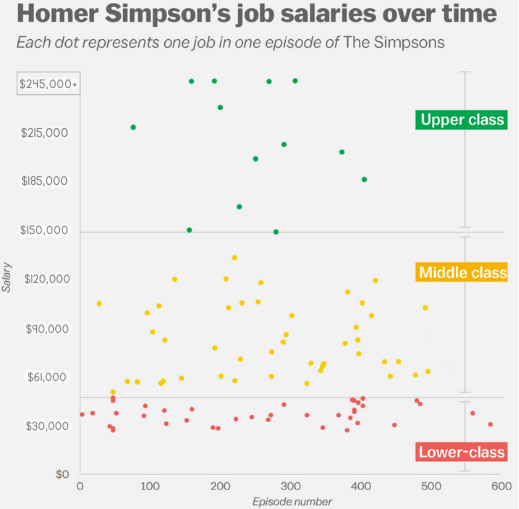
    By narrowing down Homer’s working life to around 100 real-world jobs, we can start to understand the financial trajectory of his career. Taking these jobs, we can quickly determine some average salaries. Interestingly, three of Homer’s ten highest-paying jobs were at the nuclear power plant, where he climbed the corporate ladder to roles such as executive vice president and, eventually, CEO in season 14. These brief forays into higher-paying positions highlight the occasional, albeit temporary, opportunities for upward mobility within the middle class.

    Half of Homer Simpson’s jobs fall squarely within the middle-class bracket. In stark contrast to his middle-class jobs, Homer’s stint as a walking billboard was one of his lowest points economically. Earning just $100 a week from the logos tattooed on his body, this job placed Homer much lower on the economic totem pole.

    Why should we care so much about a fictional character’s careers in a fictional town? Because Homer Simpson’s career trajectory serves as a mirror to the struggles of Australia’s middle class. By examining Homer’s ups and downs, we gain insight into the economic pressures, uncertainties, and challenges that many Australians face every day. Homer’s career path isn’t just a series of humorous misadventures. It’s a reflection of the broader societal trends that have shaped the lives of middle-class Australians. His struggles to find stability and success echo the experiences of countless individuals who are finding increasingly difficult to navigate an uncertain economic landscape. As viewers watch Homer navigate the ups and downs of his career, they are reminded that his fictional story isn’t so different from their own.

    When we chart Homer’s fictional salaries from 1989 to 2016, a clear pattern emerges. it becomes clear that from 1989 to 2016 he hasn’t really ascended the economic ladder. In plain terms, he is stuck. Homer’s inability to climb the ladder despite years of work reflects the harsh reality for many who find themselves in jobs that offer little room for growth or advancement. Sure Homer had a few wins here and there but overall he has stagnated. This stagnation is evident when we examine Homer’s fictional salaries over time:

    From the end of World War II up until the 1980s, Australia experienced a period of robust economic growth. The income of the average Australian family grew dramatically during these decades, fueled by a booming post-war economy and rising living standards. However, since the 1980s, this upward trend began to slow, and by 2010, wage growth had stagnated entirely. Economists refer to this phenomenon as the ‘middle-class squeeze. More than just a slowdown in wage growth, it represents a broader economic shift where middle-class households struggle to maintain their standard of living. As costs for essentials like housing, education, and healthcare rise, the purchasing power of middle-class incomes diminishes, leading to increased financial stress. Although Homer had brief moments of success, he never really surpassed the median income for the middle class of Australia, mirroring the stagnation that many families have experienced over the past few decades.

    Homer Simpson serves as a window into the middle-class experience—one characterized by modest comforts and the constant tension of economic uncertainty. After more than three decades, he is right where he started.

  • Prisons for profit

    The idea of prison conjures up many different images for people. For those on the right wing, prisons are often seen primarily as instruments of punishment and deterrence. In contrast, the left wing tends to view prisons as places for rehabilitation. Some people imagine the clanging of heavy iron gates shutting them off from the outside world, while others think of the unappetizing, bland food often portrayed in movies and TV shows. Almost nobody thinks of profit. 

    Most people assume that much like the rest of the justice system, prisons are simply administered by some random branch of the government. However, this assumption is incorrect, at least in Australia. Here, prisons are run by private companies with the primary goal of generating profit. In this profit-driven system, every inmate, whether convicted of a violent crime or a minor traffic offense, is seen as a source of revenue. 

    If you are unlucky enough to live in Victoria, South Australia or New South Wales the administration of prisons is dominated by four major private companies driven by profit. No wonder It’s no surprise, then, that New South Wales has the highest recidivism rate in the country, with 48% of inmates returning to jail within two years.

    When the topic of private prisons comes up, most Australians likely think of the United States. However, despite America’s reputation, Australia has a higher percentage of its prison population in privately run facilities than any other country in the Western world. At the time of writing, more than twenty percent of Australian prisoners are housed in privately run prisons, a significant increase compared to the United States, where less than ten percent of the prison population is in private facilities. This alarming disparity highlights the extent to which Australia has embraced the privatization of its prison system.

    In Australia, the prison system is heavily influenced by four major companies: Serco, G4S, Geo Group, and MTC-Broadspectrum. Each paid billions per prison with decade-long contracts. Each new prisoner represents additional revenue, akin to cattle on a farm. Together, these four companies are set to receive over half a billion dollars this year alone for their services.

    Despite the obvious issues of a private company having sway over your freedom, the for-profit prison industry poses significant challenges for both society and the economy. Put aside for a moment the irony that if the criminal is lucky enough to have a superannuation account, they may very well have a vested stake in the very company that is imprisoning them. This paradox highlights just one of the many complex issues within the for-profit prison system.

    To increase revenue, more people need to be incarcerated. That is the reality of how these companies grow. If the crime rate decreases, these companies make less money because there is less demand for their services. See the problem yet? Revenue is only half the equation. The industry is paid a fixed amount per prisoner. In order to grow their profit margin they have no choice but to bring their costs down.This is where the real problem lies. To maximize profits, companies often cut corners by providing inadequate staffing, supplies, and equipment. Medical supplies and costly renovations detract from the bottom line so why prioritize them at all. After all, shareholders won’t be happy if their dividends payment goes down. 

    This business model provides no incentive to invest in programs that help offenders stay on the straight and narrow after their release. “In fact, rehabilitative programs that aid in reducing recidivism are viewed as financial liabilities, as they only eat into the prison’s cash flow. As a result, these essential programs are often neglected, leaving prisoners without the support they need to reintegrate into society successfully.

    The companies that own and run prisons actually stand to benefit more when people reoffend. They only stand to lose revenue if a criminal is able to turn their life around, making rehabilitation counterproductive to their business model. So why would they want to rehabilitate their ‘cash cows’? The more people that are locked up, the better the financial report looks at the end of the year. Rehabilitating inmates would quite literally put them out of business.

    The idea behind privately owned and operated prisons was intended to make the system more efficient. The primary goal was to reduce costs for the public compared to government-run prisons. Politicians assured us that outsourcing prison management would be more economical, with private companies handling the operations more efficiently. We were told that nothing significant would change and that these companies were simply experts at what they do. At the end of each financial year, we were promised that the costs would be lower, making the decision seem like a prudent choice. Let’s be honest, nobody really wants to stick up for convicted criminals anyway. 

    Except it was all a lie. The cost of running prisons never got any better. The cost of running prisons did not improve. In fact, the expenses for the state actually increased. The areas in Australia that use for profit prisons have a much higher rate of repeat offenders. By all measures, our prison worsened. They didn’t even give the contracts to Australian companies, instead choosing largely international businesses that send profits back to England and the USA. What were we left with? A growing expense list and the added burden of increased crime for our communities to manage. In 2021 alone, organized crime was estimated to cost us around 60 billion dollars a year.

    Over the past five years, there has been a lot of criticism directed at judges and the judiciary system as a whole. This is especially true in Victoria, where carjackings and home invasions feel more like an epidemic than mere crime statistics. Instead of solely blaming the bail system for our issues, perhaps we should scrutinize the individuals and entities responsible for rehabilitating criminals. “People go to prison not only to be rehabilitated but also to be punished for their unacceptable behavior. Punishment is the responsibility of the judge, not some foreign CEO running a for-profit prison.

    A quick note on the article. While this article names specific companies involved in the for-profit prison industry, it is intended to discuss industry-wide practices and does not allege any wrongdoing by any individual company. The focus is on the broader systemic issues rather than the actions of specific entities.

  • The Big Mac Index.

    They’re big, unhealthy and most importantly they are available world wide. In fact, the Big Mac is sold in over one hundred countries. This widespread availability is why economists find them fascinating. No, it’s not their flavour or value for money, it is their ability to tell a story about the world from the consumer’s perspective.

    The Big Mac Index was the brainchild of Pam Woodall, first coined in the 1980s during her time at The Economist magazine. Forty years later, this quirky idea still holds relevance, with the results of the index published annually. In short, the Big Mac index shows how burger prices differ across international borders. It completely changed the way we look at currencies. More importantly, it demonstrates just how well off consumers are in each country.

    To understand the Big Mac index, you need to understand that the dollar in your pocket does not exist in isolation. Currencies exist in pairs. Most commonly in a pair with the United States Dollar. Everything is often compared to the American dollar, highlighting its central role in the global economy.

    In an ideal world, exchange rates would accurately reflect trade dynamics. The value of a currency would depend on how much it is desired compared to another. How much one dollar is wanted compared to the other. That is how the system is meant to work. If people want American dollars more than Australian dollars, the American dollar would appreciate in value. This leads to the famous idea that over time through the law of averages, prices across the world should smooth out. That everything in one country would cost the same equivalent in another country. Essentially, after adjusting for exchange rates, products should have the same price in different countries.

    Sneakers provide a good example. If a pair of sneakers were one hundred dollars in the USA, then they should be the equivalent of one hundred USD here in Australia. At the time of writing this, that would be roughly one hundred and fifty dollars AUD. However, every sneakerhead knows this is rarely the case. In fact, most consumer goods are cheaper in America, even when we adjust for the exchange rate.

    This discrepancy presented economists with a problem. If sneakers cost Australians three hundred dollars, what was happening? It is clear that consumers were better off in some regions and worse off in others. Deliver the Big Mac.

    Perhaps the most famous burger in the world, the Big Mac, offers a unique advantage for economic comparison. Unlike sneakers, which vary greatly in type and price across countries, the Big Mac is remarkably consistent. It fits the mold perfectly. It is readily available in almost every country, with the same raw ingredients, marketing, and packaging. It is easily recognizable and simple to record. In fact, a quick Google search will give you the raw data almost instantly.

    Let’s say a Big Mac is two dollars in America and an exchange rate is a straightforward one point five. If everything were perfect and everyone paid the same for the burger, Australians would pay three dollars. Any other price tells you if consumers are better or worse off. If Australians only paid one dollar, they would be better off than Americans. If they were paying four dollars, they would be worse off. This simple concept has revolutionized the way we measure economies around the world. How much more or how much less someone pays for the same burger indicates whether they will pay more or less across the entire economy.

    It comes as no surprise that the latest Big Mac Index (2024) shows consumers in Switzerland and Norway are far better off than most of the world. Australia has experienced a considerable dip in its standard of living this past year, so it is not surprising that Australian consumers were worse off than Americans this year. South Korea and Hong Kong are also worse off yet again

    Why even bother tallying up the price of burgers each year? Over time, the assumption that prices would equalize for consumers worldwide has proven unreliable. Despite it being easier than ever to transact globally, international commerce still lags behind.

    Of course, there are obvious factors causing these price discrepancies. Taxes on imports and government policies all significantly influence pricing—just look at the global car industry as an example! Petrol could not possibly be the same price across borders when each government taxes it differently. These make sense and at least for the time being consumers are going to have to cop that reality.

    There are also less obvious reasons why consumers are worse off in certain countries. For instance, while sneakers might be more affordably priced in America, it’s impractical for someone from Melbourne to fly twenty-three hours just to go shoe shopping. The idea that prices will smooth over time probably doesn’t take into account just how impractical that may be for everyone.

    Younger e-commerce brands treat consumers much better when it comes to price uniformity. If you’re willing to pay for international shipping, you’ll likely pay the same equivalent price regardless of your location.In contrast, legacy brands—established before 2013—often maintain separate websites for each country, resulting in price discrepancies that disadvantage non-American consumers. These brands operate almost as separate entities, maximizing profits to send back to America. For instance, the renowned swoosh running brand charges Australians significantly more for shoes than Americans pay. Yet your favorite streetwear brand that is e-com only will ship it to you anywhere in the world for the same price regardless of where you are.

    The unfortunate reality is that these large companies often engage in questionable pricing practices without facing significant consequences. For consumers who cannot afford to fly to the United States for shopping, there are limited alternatives. Australia, in particular, has struggled to develop its own major brands and heavily relies on American and British companies for the latest sneakers, handbags, and clothing. A visit to a large shopping center reveals crowds of teenagers eagerly seeking the latest fashion from these American retailers. Australian stores are noticeably scarce, and those that exist tend to be perceived as budget options rather than trend-setting brands.

    That is why the Big Mac is so important to international finance. That one burger keeps track of how much the consumer is getting screwed in each and every country.

    A quick note on the article: the examples where numbers are used are just examples and do not represent the actual index. For the sake of simplicity i kept the numbers basic rather than using complicated mathematics to demonstrate the point.

    Have you ever felt like you missed out on a proper financial education? Nearly two years ago, I wrote a book designed to help people build a solid financial foundation. You can check it out here.

  • Luxury Prizes or Empty Promises?

    We’ve all seen the Facebook ads flooding our feeds, promising luxury cars and expensive prizes. Hundreds of companies claiming you can win a luxury car for only five dollars. Luxury handbags, money and houses are all part of the promotion for these companies. Once you’re in their funnel, it can be hard to escape the bombardment of these ads. They seem to have a never ending budget for advertising and, judging by the comments, an endless supply of victims as well.

    Running a for-profit raffle is illegal in Australia. That’s why, in most cases, you aren’t actually buying a ticket to the giveaway. Instead, you usually sign up to be a “member” of a rewards program. That is the loophole that has caused this industry to explode. You can’t raffle off a new mustang but you can give it away to your members. These companies claim that they run these giveaways to promote membership. Thus exploiting a legal loophole, where members barely even know about the rewards program they have just joined.

    If you visit the endless number of these giveaway websites, you know as well as I do that it’s almost always impossible to tell that there is any member program at all. The companies may use it as a legal shield, but it isn’t their true business model. People aren’t signing up for ten percent off a brand that no one has ever heard of. They are signing up because they believe they can win the car, handbag, or other luxury item being dangled in front of them.

    Understanding why the majority of these companies are running a scam isn’t immediately obvious. Although they often use a legal loophole to operate, this doesn’t automatically mean they are screwing over their customer base. Unfortunately in this industry, the devil is in the details when it comes to how they are screwing them. More specifically, the devil is in the subscriptions. 

    Put aside for a minute that the industry is unregulated due to the legal grey area it operates in. Put aside the fact that no one oversees who actually wins and how the winners are chosen. For a moment pretend like everyone is honest all the time. Even if that was the case, the industry’s reliance on subscriptions is where they are truly screwing their “members”. 

    The real money spinner for this industry is accruing entries. There is no point spending all that money on advertising to their audience, only for that person to only buy one ticket. Chances are, when they don’t win, they won’t be rushing to sign up for another ticket will they? That’s why most of these companies offer subscriptions. ranging from $10 to $500 a month, there is a tier for every income level. To make it worth signing up, they sweeten the deal. For many companies, the entries build up over time. That is to say, the longer you are a member, the more entries you receive for each giveaway. It’s built-in loyalty.

    Each month, members think they are getting closer to a win by staying loyal. In reality, they are running in place. To put it plainly, if a member gains just one extra entry a month and stays for a full year they are twelve times more likely to win than a brand new member. Meaning that if you weren’t in the first hundred members, you will be so far behind those who were. Now put those numbers on steroids. These companies sell premium packages worth hundreds of entries a month. Many have been running for much longer than a year. New members quite literally have no chance at winning. The old members hold all the tickets. In fact, unless you were one of the first members, your odds are nonexistent. That’s why they never tell you the odds.

    Despite selling nothing but hope, people haven’t caught on to the scam. There should be hoards of angry mobs banging at the gate, yet for some reason there aren’t any. In fact, it’s actually quite hard to find even a negative comment on each social media post. The key to it all is that the operation is always intertwined with the charming personality of a social media influencer. Their target customers aren’t only fans of the giveaways, they’re fans of the person giving the stuff away as well. If you look at the comment section of these social media posts, you’ll often see a parasocial relationship being exploited.

    “Parasocial relationship” is a term you may not have heard before. It is used by psychologists to explain the one-way relationship between celebrities and their fans. In modern times, parasocial relationships are on the rise thanks to the unprecedented access that social media provides to your favorite stars. 

    In the past, fans may have loved the work of a certain movie star, laughed at their interviews or even have identified with the characters played on the big screen. Now, thanks to Tiktok and Instagram, people spend far more time with celebrities, whether they are big or small. People can comment on and message their favorite influencer with unprecedented access to their lives 24/7. This happens all whilst the influencer has no idea who the person even is. The audience is familiar with every aspect of their lives whilst the celebrity is none the wiser. The audience is essentially anonymous to them.

    As strange as this may sound, these parasocial relationships are exactly what is being exploited by these trade giveaway companies. In fact, it is the defining feature of the industry leaders. One leader has even gone on to say that it is not possible to run a trade giveaway successfully without the organic audience (i.e., fans) to sell too. These influencers are often promoting a life that many wish they could lead themselves. On top of this, they give away the chance to obtain a piece of it to their audience with their so-called “giveaways”.

    When you don’t have a young charming face, funny friends or a beautiful wife to flash in front of the camera, you can always hide behind one off payments to charities in order to use their name on your marketing material. That way, people who see your ads think the money from the tickets is going to a good cause. Better yet, start your own charity where only thirty percent of the funds need to actually help anyone, and the other seventy percent can be used for expenses. For example, spending ludicrous amounts of money on cars, boats and stunts that will make the news to further push the trade giveaway business’s name and profit margins. Just be sure that charity is a separate entity so no one is the wiser.

    Amidst all of this, real-life stories of deception highlight the true cost of these so-called giveaways. Take the case of an unfortunate woman who thought she had won a luxury car. Elated, she soon discovered that the car she had “won” still owed a significant amount of finance. Instead of receiving a dream vehicle, she was saddled with unexpected debt. This tale underscores the importance of understanding the fine print and the reality behind these enticing offers.

    As these dubious giveaway schemes continue to flourish, it’s crucial for consumers to understand the true nature of these promotions.  It demonstrates the powerful, often manipulative, sway that influencers hold over their audiences. While regulations may eventually catch up with this gray area of commerce, the onus is also on consumers to be more discerning about where their money goes. Until then, these companies will continue to exploit both legal loopholes and the trusting nature of their followers, selling dreams that, for most, will never come true.

  • Big Business Grip on Australia

    Should we split up our major supermarkets? That is just one of the many solutions proposed in order to relieve the cost of living pressures on Aussie families. Right now, Woolworths and Coles makeup over sixty five percent of market share. If you include Aldi, only three supermarkets make up seventy five percent of the industry as a whole. Over three quarters of the market encaptured by only three companies. To put it plainly, they capture over eleven billion dollars each year.

    Just to get everyone up to speed, a duopoly is when two companies dominate most of an industry. An Oligopoly is where a small handful of companies dominate the industry. When duopolies or oligopolies occur, they hurt competition. At the end of the day, the less competition there is, the more expensive it will be for consumers. In an ideal world, we want lots of competition to make things cheaper.

    Truth be told, Australia is obsessed with stifling competition. Our supermarkets are undeniably a duopoly however it doesn’t end there. We have only two major telcos, four major options for insurance and two alcohol retailers. Major retailers are not exempt either. Big W competes against Kmart and Target, except Kmart and Target are owned by the same company. Again, yet another Duopoly. When you fuel up your vehicle, you have at best four options. Powering your home leaves you with only three major options.

    It’s no secret that consumers are starved of competitive options when spending. The excuse? It helps your super balance. The retirement of millions of Australians is pegged to the success of these handful of companies.

    When situations like this arise, there are always concerns about price gouging. After all, the consumer doesn’t have much choice. If they want the product, there aren’t many places they can go so prices rise. That can go to extremes if left unchecked. What is more likely to happen is that quality and service drops. Consumers are worse off because businesses don’t have to worry about providing proper customer service. They don’t have to worry about quality. Where is the consumer going to go? There aren’t many competitors. As this happens, quality standards dip across the industry where the oligopoly has taken hold.

    Think about it for a minute. Do the two largest telcos in Australia provide good customer service? Exactly. Have petrol prices crept higher in the past decade? Exactly. Ever tried to make an insurance claim and been treated like a criminal? I could go on and on, though every industry that is dominated by a handful of players in Australia but i think you get the point.

    The worst part of this all is that the longer it goes on, the harder it is to fix. Unfortunately it’s been going on since at least the early 2000s. Some experts believe that this is a problem across capitalism as a whole. That if left to run long enough, oligopolies and then duopolies are inevitable. In a completely unregulated market this might be true. Lucky for us, our society isn’t an unstoppable boulder rolling down a hill.

    As obsessed as Australia is with duopolies, the government has options. The most extreme is to force these duopolies to break apart. Most recently, this was suggested as a solution by the Greens party as a result of high grocery prices. This solution is extreme, it entails quiet literally breaking the business apart into smaller businesses. It would force the major grocery stores to sell off each part of their business. The fruit department would become its own business, the deli would split away and become a separate business and so on. The idea is that with so many smaller businesses in the market, the only way they would be able to compete is by lowering prices.

    On the surface it sounds like a great way to lower prices for consumers. Underneath however it presents a few problems. The most obvious is that it would be a long legal process. None of the Australian duopolies would quietly agree to be split up. They would draw it out in court, fighting it every step of the way. This would obviously be expensive for the taxpayer. That isn’t the main reason that the government is unlikely to take this route. Let’s be honest, the government overspends all the time.

    So why is there such a resistance to this idea? The answer is your superannuation balance.Considering the immense scale of these duopolies in Australia, you will be hard pressed to find a company large enough to possess them. Unlike America, Australia’s large retailers are not owned by rich families. Instead the vast majority of all duopolies in Australia are either owned by foreign entities, or more frequently Superannuation forms.

    That is where the issue is. If the government came in to break apart these large Australian brands, their stock price would be obliterated. Even a legitimate threat of a breakup could send the value of these brands plummeting. Investors just don’t want the risk so they flee the stock. The vast majority of super funds hold a huge quantity of stock in these large duopolies. If there was a breakup, it would most certainly halt retirement plans for millions of Australians.

    You can’t break the stranglehold these companies have on Australia without screwing Australians in the process. There is another path Australia can take. It involves a combination of protecting small businesses and encouraging new ventures.

    One of the ugliest elements of Duopolies is where the largest entities wield so much power, they can bully small time suppliers on price. Whilst they bully down suppliers for a lower wholesale price, they fail to pass that onto the consumer. There are many, many farms that regularly have to sell their produce below their cost to our larger supermarkets because the farmers have no one else to sell to. They essentially have no choice. Neither do consumers. Small suppliers that work with these Duopolies need better protection. This would ironically allow more competition in the market.

    This problem has been growing for decades. It’s going to be very difficult for the country to overcome. Four decades ago, it wouldn’t have been a wild idea that someone could start a supermarket business and grow it. Now, coming up against the two giants that own the supermarket industry seems like complete madness. It’s just not possible for someone to start a small local supermarket and survive.

    There needs to be policy to help incubate and foster new brands and new companies, particularly in the industries with low competition. These policies should come together to promote competition, bringing prices down for consumers. The weekly grocery shop shouldn’t take up more than half a week’s wage. It would also ensure that the superannuation firms aren’t hit with any major shocks. The millions of Australians that have put their retirement in the hands of those companies will be fine.

    The simple fact is, there shouldn’t be two companies dominating each industry in a country of over twenty six million people. We deserve better.

    We understand that every penny counts when you’re working towards financial freedom. That’s why we’re thrilled to announce a price drop for the Kindle edition of Wealth Kingdom. This is your opportunity to delve into my book that demystifies money management, debt reduction, and wise financial decision-making. Check it out here.

    Special thanks Statista for providing their data on supermarkets and marketshare, Finder for their raw data on supermarket revenue.

  • The Impact of Daylight Savings on the Economy

    This month Daylight savings will end, and the clock will go backwards. The lower eastern states of Australia will be plunged back into darkness before 7 P.M. and their spending will fall off a proverbial cliff. That is the economic impact of daylight saving, but it goes further than most would realise, in ways that are not immediately obvious.

    Come next october, people will furiously debate if it is really necessary to move the clocks forwards again. Ever wondered how that one-hour shift twice a year can ripple through our economy? Over the past twenty years, more and more states are ditching the time switch. Now only the four most southern states in Australia participate in daylight savings. Let’s be honest though, if you are from one of those southern states who doesn’t want an extra hour of sunlight in their evenings? Despite having an uplifting effect on everyone’s mood, it also has an effect on your wallet quite significantly. 

    There are historical reasons for daylight saving, notably energy consumption. One of the original reasons for adopting daylight savings was to lower household energy consumption. The idea being that people would spend a combination of more time outside and less time with the lights on in their house. When first introduced during World War Two, it made a certain amount of sense. They were looking to conserve the nation’s resources. They desperately needed coal for the war effort, rather than powering peoples homes. 

    Now, the advent of modern electronics has likely wiped out most of the positive environmental impacts caused from daylight savings. On top of that, we rely less on coal for our electricity in modern times. At best, in a modern home the energy consumption savings is no more than 0.34% during daylight savings. That is less than a half of one percent. Not quite sure how much that is actually helping.

    Shifting our focus to the economy, daylight saving significantly influences retail and restaurant spending. The most obvious benefit of daylight savings is an increase in sales. Unfortunately I am not referring to discounts but rather an increase in transactions for businesses.

    Retail benefits the most with far greater foot traffic at major shopping centers. Personal budgets benefit the least. This is because retail spending increases by ten per cent across the board during daylight savings. 

    Restaurants also see a large increase in spending. Although unlike retail, location often plays a larger factor on just how much of an increase the restaurant will see during summer. This makes logical sense because you’re more likely to sit at a nice restaurant in nice weather. You’re probably less likely during winter when it’s cold and raining to sit by the beach and eat at a nice restaurant. Daylight savings prolongs that time frame that people will sit down to eat. Instead of it being dark and gloomy by 7, you can sit until 9 and enjoy the nice weather. This is especially true for weekdays, with the effect on weekend spending being far less. In fact, daylight savings has basically no effect on spending on sit down meals during Friday and Saturdays.

    This might not sound like much on paper. While these figures may seem modest, they translate into a substantial economic contribution. A few dollars extra here and there. Maybe an extra meal out in January for everyone. The truth on the matter is that daylight savings is worth roughly twenty one billion dollars to the Australian economy. That’s right, on average we will collectively spend roughly three and a half billion dollars more than usual for each month of daylight savings. No wonder there is such a resistance to any notion of getting rid of it. 

    What may come as a surprise to some is that not only will total takings be up for both retail and restaurant the average each customer will spend also goes up. It seems people are just far more likely to spend frivolously the longer the sun is out.

    Daylight savings has another, at first less obvious benefit to our economy. Beyond its economic implications, daylight saving also plays a role in societal well-being. There is considerably less crime. More specifically, less robberies. Criminals seem to like the cover of darkness, with more light for longer they have less cover to commit robbery. At first you would think that the robberies just moved in the time that they occurred. After all, daylight savings doesn’t mean no sunset. That reasonable presumption would be wrong. Overall robberies decrease by roughly seven percent a day during daylight savings. 

    It’s not all sunshine and rainbows however, in the day that follows the clock change over an estimated four hundred million dollars of productivity is lost. Workplace accidents go up the week of the change to daylight savings as well. Doctors have found a roughly eleven per cent increase in depressive episodes in the month that follows the end of daylight savings. 

    So what do you think? Is daylight savings worth the loss of sleep? How about the headache of moving your clocks forward?

    If you liked this article, you’ll love my book! It’s not your usual snooze-fest on finances. Nope, it’s packed with easy-to-digest tips and tricks to help you get savvy with your money.  Check it out here.

    Special thanks to MIT for their data on crime rates, Muenchen University for their insights on energy consumption, and JP Morgan Chase for their information on retail spending. Your contributions were invaluable to this article.

  • The business of footy

    After a one hundred and sixty day hiatus, the AFL will return to our screens this week. Crowds will stream into stadiums, commentators will put their headsets on once more. we will yell and shout at our TVs as if our voices could alter the trajectory of the football through the air. Many of us know the player names and the coaches history but have no idea about the money behind the league we love. This season alone, the AFL is predicted to make over one billion dollars!

    In 2022, the AFL proudly counted a whopping one point one million members across all its clubs. Throughout the season a total of six million seven hundred thousand individual people walked through their gates. Their largest TV audience will come as no surprise to anyone with over one million people tuning in to watch the Anzac Day clash. All of this helped build a sizable revenue of nine hundred and forty four million dollars for the 2022 season. Not bad for a sports franchise on its knees pleading to be saved by the banks only two years prior.

    From that almost billion dollar payday, tv revenue made up almost a third of their revenue, with sponsorships making up another third. Surprisingly, coming off the back of COVID disruptions to the game, government grants and handouts made up less than ten percent of their overall revenue.

    Of course the AFL as a whole is made up of eighteen teams. Interestingly, of their near billion dollar revenue, they redistributed three hundred and thirty seven million to the clubs. That’s less than thirty percent of their revenue. Not all clubs are as lucky as some others though. The gold coast suns are still being propped up by the AFL with a payment of twenty eight million dollars. The club with the least amount of support? That would be the West Coast Eagles only receiving twelve million seven hundred thousand from the AFL.

    On top of their cash handouts the AFL also guaranteed loans for ten clubs totalling thirty five million dollars. Ever wondered who funds the AFL? In this case it was mainly loans issued by Westpac and NAB. Remarkably, Brisbane received the largest loan with a staggering eight million dollars, whilst St Kilda also received six point seven five million dollars in loans.

    Along with the AFL earning almost a billion dollars as a league, the clubs also earnt their own revenue through sponsorships, membership/ticket sales and merchandise. For 2022 the statistics were a little skewed. Hawthorn made in excess of a thirty five million dollar profit, however it predominantly came from selling a number of venues that they had previously owned. If we remove the sale of those venues, hawthorn made just over three million dollars. Similarly, Carlton made a profit of seventy odd million dollars however that too mostly came from a strange place. That is to say, Carlton received a ginormous donation from one wealthy member.

    Outside of one off circumstances, the club with the highest profit was St Kilda with a staggering nine million dollars in profit. On the flip side, GWS lost over a million dollars and the Sydney Swans scraped through with only a thirty eight thousand dollar profit.

    For many clubs, the vast majority of their revenue actually doesn’t come from footy at all. Rather, they own different pubs, restaurants and gambling establishments. It’s worth noting that unlike many clubs North Melbourne Football Club managed to turn a profit of more than six million dollars without any gambling facilities at all. A stance the club has had since at least 2016.

    All that money flowing down from the AFL to the clubs doesn’t stop there though. In 2022 there were twelve players on million dollar contracts or better. The current highest paid player is on a whopping two million eight hundred thousand dollars. Max Gawn isn’t alone on mega money however, with over seventy players on contracts above eight hundred thousand dollars or more. The average player you ask? Just slightly above four hundred thousand dollars.

    So where does all that money go? An AFL club hasn’t had a private owner in well over twenty five years. That is to say, It doesn’t go straight to some billionaire like other major sports leagues around the world. In fact, The club ownership for the vast majority of AFL clubs is what really makes this sport stand out from the rest of the world. For the vast majority of clubs, the owners are the members, however each year membership is reset and must be repurchased. The members don’t get the money, in fact they pay the club for the privilege of being a member.

    Instead of any one group reaping the benefits, the community and football system as a whole receives the benefits. Players get better contracts, clubs run community days and provide outreach programs within their local community. The AFL also runs one of the best juniors programs in the form of AusKick each year as well. A lot of the excess cash clubs have will be burnt through running the club in the coming years. Surprisingly club presidents do not get paid in the AFL.

    That my friends, is the business of Football!

    Hey, guess what? I wrote a book! If you’re looking to pick up some money smarts that school didn’t dish out, give it a look.

    It breaks down everything from kicking debt. Starting to invest and building your wealth. It’s basically the lowdown on money that school forgot to mention, wrapped up in one book.

    Check it out here.

    Data for the article provided by the AFL 2022 financial report, available to the public.

  • From Start to Retirement

    Superannuation, when the topic comes up most people tune out. Some stress over their super balance. Others haven’t a clue how much is in there to begin with. Young people often don’t think much about it and the oldies wish they thought about it sooner. Many are completely unaware how the whole system works. 

    So how much should you have put away for retirement? That answer depends on a few things. It’s recommended that by retirement (roughly sixty five) you should have a balance of at least five hundred and fifty thousand dollars in Australia. The experts recommend a minimum balance of three hundred and sixty thousand dollars at age fifty five and just short of two hundred thousand dollars by age forty. 

    If you are only getting started with your career, at twenty five they recommend having at least eighteen thousand dollars in your super account. Although by thirty you should have almost sixty thousand dollars according to the so-called experts. 

    That was a lot of numbers so bare with me. It is all good and well to tell people what they should have in their account. The reality is different to the textbooks. Sixty five year old men on average have four hundred and thirty six thousand dollars. It’s even worse for women of that same age. Average Australians retire with over $100,000 less than recommended.

    Is it that bad for everyone younger than them? Mostly. The average forty year old male is one hundred and seven thousand dollars behind the recommended balance. The average thirty year old is about forty two thousand dollars behind. The average twenty year old male has less than 50% of the recommended balance. The stats are all slightly worse for the average Australian female as well, trailing slightly behind men in all age demographics.

    Let’s be honest though, how much we need for retirement is deeply personal. Although averages are great for statistics, they kind of suck at telling the whole picture. Ironically most Australians don’t sit on the average. Some people earn more and some people earn less. This will affect their super balance. Some spend more and some spend less. This will affect how much money they really need to retire comfortably. 

    That’s the key to the whole thing. You want to be able to retire comfortably. You don’t want your quality of life to dip too much. No one wants to retire just to count their pennies. Too many retirees have to worry about whether they can afford their groceries each week. You don’t want to be in that position at seventy five. 

    It can be hard to know just how much you will need to live comfortably. If you are used to an eighty thousand dollar income, and you are planning to work up until your seventy, then you will likely last longer than someone that is used to spending one hundred thousand dollars a year working the same time. 

    Let me break it down further. If you have the recommended five hundred and fifty thousand dollars in your super, and you spend fifty thousand dollars a year then your money will last roughly eleven years. That is your total balance, divided by your spend. Someone spending eighty thousand dollars on the same super balance would only last six and a half years. That is 550/80 = 6.8 years. Total Balance divided by yearly spend. 

    Of course it is worth noting that presuming you have paid off your mortgage it is likely you will have less expenses than the average worker. Kids have usually long moved out which also reduces expenses. Most retirees aren’t spending eighty thousand dollars each year. However many Australians have dreams of traveling using the money in their superannuation. So you would need to deduct any major purchases like travel or new cars from the total balance to get a more accurate idea of just how long your retirement could last. 

    With this knowledge, most Aussies quickly figure out they are desperately short on where they should be for the retirement lifestyle they want. So what’s the best way to grow your superannuation? Of course the best advice for yourself will come from a professional who knows the ins and outs of your finances. I highly encourage people to consider tailored advice. 

    As a general rule, there is a risk line. As you move from younger to older in your working career, you can afford to take less risks. This makes a lot of sense. Someone retiring next year probably can’t risk their money being lost as they will need it in the near future. That being said, a twenty year old has a long time to invest their money, they won’t be retiring any time soon. It only takes a moment to realize that a normal twenty something year old can take a few more risks than a sixty five year old. They won’t need the money as quickly, they have time to make it back up and recoup losses. They can also afford to invest on a longer time horizon. A sixty five year old now will likely have passed away before the twenty year old has even finished their working career. 

    Picking the right allocation is the best thing you can do. Aussies closer to retirement shouldn’t be risking as much as the Aussies who are much younger. You can picture your work life in a straight line. At one end, young ones take higher risks and at the other end, those close to retirement protect what they have. As we move through our work life, we move away from high risk towards the conservative approach the closer we get to retiring. Thirty five year olds can risk more than fifty year olds and so on. 

    For those who are young, the best way to get ahead is to pay attention to your superannuation whilst you are young. Investments need time to grow. The longer someone waits to start planning for retirement the harder it will be for them to hit their target balance. Just as an example, two hundred and fifty dollars a month will turn into over eight hundred thousand dollars if you start at age twenty five, however if you start by age thirty five, it will only grow to around three hundred and seventy five thousand dollars. Even worse, if you wait until forty five, it will only grow to one hundred and forty eighty thousand dollars. Of course this all on the averages, presuming a rate of return of eight per cent annually. Most superannuation funds will be able to hit an eight per cent rate of return consistently. If you are lucky enough to still be young, pay attention to that superannuation account early! 

    Wealth Kingdom

    For those of you who don’t know, I wrote a book! If you are interested in learning the financial foundation you never received in school you can check it out here

    It covers the basics of getting out of debt, all the way to building an investment portfolio in easy to understand language for everyone. All the things school never taught you about money, in one book. 

    *Data for this article was provided by QSuper. 

  • Bulls, Bears and Bitcoin ’23

    First time investors would be forgiven for thinking this whole industry is a giant scam. 2023 was a year defined by uncertainty and volatility. No doubt a year to forget for many investors. Bitcoin prices performed the best. Stocks performed quite badly for the majority of the year, only to be saved by a December rally to close out 2023. Many Stock market investors were left with their tails between their legs as the market dove in February and again in June. It wasn’t all doom and gloom though, with markets rallying above the January start in December. Crypto was even more volatile, with many price dips along the way, climbing back towards high highs faster than the stock market at times. 

    For an investor who invested a thousand dollars in the ASX200, the current value of their investment stands at roughly 1100 dollars at the end of December. The stock market faced significant challenges primarily driven by concerns about dwindling consumer demand. The decision of the Reserve Bank of Australia to raise interest rates added to the unease, prompting investors to scrutinize the potential impact on consumer spending throughout the year. Global conflicts further exacerbated the situation, particularly for Australia, given its reliance on exports. Any disruptions overseas tend to have adverse effects on the country’s markets, contributing to the complexities faced by investors. Then December hit and the Santa rally began. Almost all the gains in 2023 for the ASX200 were made during December.

    First-time investors might find themselves a bit more apprehensive, especially if they ventured into individual stocks, given the heightened volatility experienced throughout the year. Depending on the timing of their purchases, many newcomers to the market may discover they are still grappling with losses. If an investor started at the beginning of this year in stocks and checked their account half way through the year, they’d probably be cursing. The unpredictable nature of market fluctuations has left some first-time investors feeling somewhat bruised. It’s times like these that it’s good to remember that investing in the stock market is for the long term!

    The real estate market was a story of two halves. There were moments where it looked like doom and gloom. Other moments looked like the highs would only become higher. Overall the market finished off Higher than the start of the year. Whilst interest rates made it more expensive to purchase a home, higher than usual immigration and overseas demand continued to pump money into the real estate market. Although some investors will see better returns than others. Certain cities shrunk in value and less houses were being sold. December was a particularly bad month, with cracks beginning to form in the Sydney and Melbourne markets. 

    In Melbourne, the average house owner added a modest 4% to their asset value. In Sydney it was 11% and Brisbane it was 8%. Although not everywhere was sunshine and rainbows, it was still possible to make a handsome return. In the end, although there was a lot of talk about a housing collapse, they were ultimately wrong.

    Crypto finished up the year quite strong. To clarify, when I mention crypto in this article, I am specifically referring to the big two. Bitcoin and Ethereum. By far, the two largest coins in the market. Whilst Bitcoin took at least 3 major dips in price in 2023, it managed to finish the year quite far ahead of where it started. If you purchased one bitcoin at the start of the year, you would be up $40’346. That is an increase of 171% for the year. Etherium pretty much trailed bitcoins price at a much lower level. It also managed to be up by more than 96%. If you purchased one ethereum on January 1st 2022, you would have gained $1721 dollars by January 1st 2023. 

    Similar to stocks, crypto investors might experience a sense of being bruised and battered. The year witnessed numerous highs and lows, marked by at least three major price crashes throughout the year. The heightened volatility may have posed a mental challenge for newer investors. Unfortunately when it comes to investing, up is rarely a straight line. Many investors would likely have exited the market multiple times with such volatility rather than waiting for the year end.

    Stock investors were better off than they had been in 2022 but only because December was a big month! Similarly Real estate investors were also better off than they were the previous year despite all the doom and gloom commentary. Crypto far outperformed other markets but only if you held the whole year. Naturally, each individual’s portfolio is unique. Performance relative to the market will depend on how each of us allocated our funds. Investors may discover that they have either outperformed or underperformed based on their specific investment strategy.

    A new year has dawned, and 2024 holds its distinct set of challenges and opportunities. Seasoned investors are likely to be revaluating their portfolios in the coming weeks, reflecting on the past year and making strategic adjustments. If you entered the investment arena for the first time in 2023 and faced challenges, don’t be disheartened—every setback is a learning opportunity on the path to financial growth.