Homer Simpson can teach us a lot about the middle class of Australia. In 1995 Homer Simpson turned to his wife Marge as they walked through downtown Springfield warning her “These are dangerous streets for us upper lower middle class types”. This marks Homer’s first real acknowledgment of his place in the middle class—a fact that’s been apparent to viewers for years. Homer’s life, characterized by a modest home in the suburbs, two children, and a wife who mostly stays at home, embodies the aspirational yet often elusive Australian Dream. Homer’s lack of formal qualifications and his reliance on a blue-collar job at the nuclear power plant speak to the realities faced by many in the middle class.
The Simpsons middle class status is confirmed again in Season 7 when we get a glimpse of Homer’s paycheck. The glimpse of Homer’s paycheck is more than just a detail, it’s a concrete representation of his middle-class status. According to Homer’s paystub, his pre tax weekly pay is $479.60, which comes out to 11.99 an hour. That makes Homer’s annual salary $24, 395. Homer’s hourly wage of $11.99 might seem low by today’s standards, but when compared to the average wages of the mid-90s, it positions him squarely in the lower end of the middle class. When we adjust for inflation and convert to the Australian dollar that brings Homer to just above 60 thousand dollars in today’s terms.
If we look at the real town of Springfield, often thought to be the real life inspiration for the fictional town, this salary places him smack bang in the lower middle class bracket as well.This paycheck, earned from his steady job as a safety inspector at the nuclear power plant, underscores Homer’s position within the economic hierarchy of Springfield. Despite his long-term employment, his earnings keep the family on the edge of financial stability. The interesting thing about Homer is that this hasn’t been his only job. The sheer variety of jobs Homer has held over the show’s 35 seasons—from astronaut to car salesman – was hard to quantify at first. In 35 seasons he has had over 200 “jobs” and counting. These jobs have placed him across a wide economic spectrum.
Despite the wide range of jobs, Homer’s identity remains rooted in the middle class, revealing how adaptable—and sometimes resilient—this economic group must be to survive.From Astronaut to Baseball mascot, Mayor to Carney and every job possible in between. He has even spent time as a fortune cookie writer. Homer’s career has been diverse both in roles and in pay. Some of these careers are literally impossible to find salaries for (i.e. Beer smuggler or being the Grim Reaper). He’s also worked seasonal jobs like playing Santa at the mall. Analysing Homer’s ascent up the economic ladder meant we had to leave some of these out for practical reasons.
By narrowing down Homer’s working life to around 100 real-world jobs, we can start to understand the financial trajectory of his career. Taking these jobs, we can quickly determine some average salaries. Interestingly, three of Homer’s ten highest-paying jobs were at the nuclear power plant, where he climbed the corporate ladder to roles such as executive vice president and, eventually, CEO in season 14. These brief forays into higher-paying positions highlight the occasional, albeit temporary, opportunities for upward mobility within the middle class.
Half of Homer Simpson’s jobs fall squarely within the middle-class bracket. In stark contrast to his middle-class jobs, Homer’s stint as a walking billboard was one of his lowest points economically. Earning just $100 a week from the logos tattooed on his body, this job placed Homer much lower on the economic totem pole.
Why should we care so much about a fictional character’s careers in a fictional town? Because Homer Simpson’s career trajectory serves as a mirror to the struggles of Australia’s middle class. By examining Homer’s ups and downs, we gain insight into the economic pressures, uncertainties, and challenges that many Australians face every day. Homer’s career path isn’t just a series of humorous misadventures. It’s a reflection of the broader societal trends that have shaped the lives of middle-class Australians. His struggles to find stability and success echo the experiences of countless individuals who are finding increasingly difficult to navigate an uncertain economic landscape. As viewers watch Homer navigate the ups and downs of his career, they are reminded that his fictional story isn’t so different from their own.
When we chart Homer’s fictional salaries from 1989 to 2016, a clear pattern emerges. it becomes clear that from 1989 to 2016 he hasn’t really ascended the economic ladder. In plain terms, he is stuck. Homer’s inability to climb the ladder despite years of work reflects the harsh reality for many who find themselves in jobs that offer little room for growth or advancement. Sure Homer had a few wins here and there but overall he has stagnated. This stagnation is evident when we examine Homer’s fictional salaries over time:
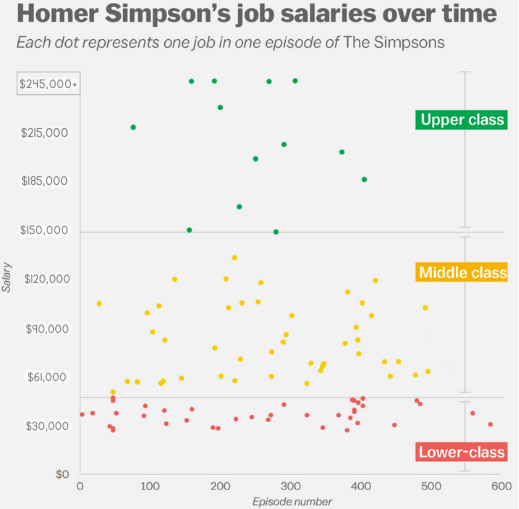
From the end of World War II up until the 1980s, Australia experienced a period of robust economic growth. The income of the average Australian family grew dramatically during these decades, fueled by a booming post-war economy and rising living standards. However, since the 1980s, this upward trend began to slow, and by 2010, wage growth had stagnated entirely. Economists refer to this phenomenon as the ‘middle-class squeeze. More than just a slowdown in wage growth, it represents a broader economic shift where middle-class households struggle to maintain their standard of living. As costs for essentials like housing, education, and healthcare rise, the purchasing power of middle-class incomes diminishes, leading to increased financial stress. Although Homer had brief moments of success, he never really surpassed the median income for the middle class of Australia, mirroring the stagnation that many families have experienced over the past few decades.
Homer Simpson serves as a window into the middle-class experience—one characterized by modest comforts and the constant tension of economic uncertainty. After more than three decades, he is right where he started.
 Wealth Kingdom
Leave a comment